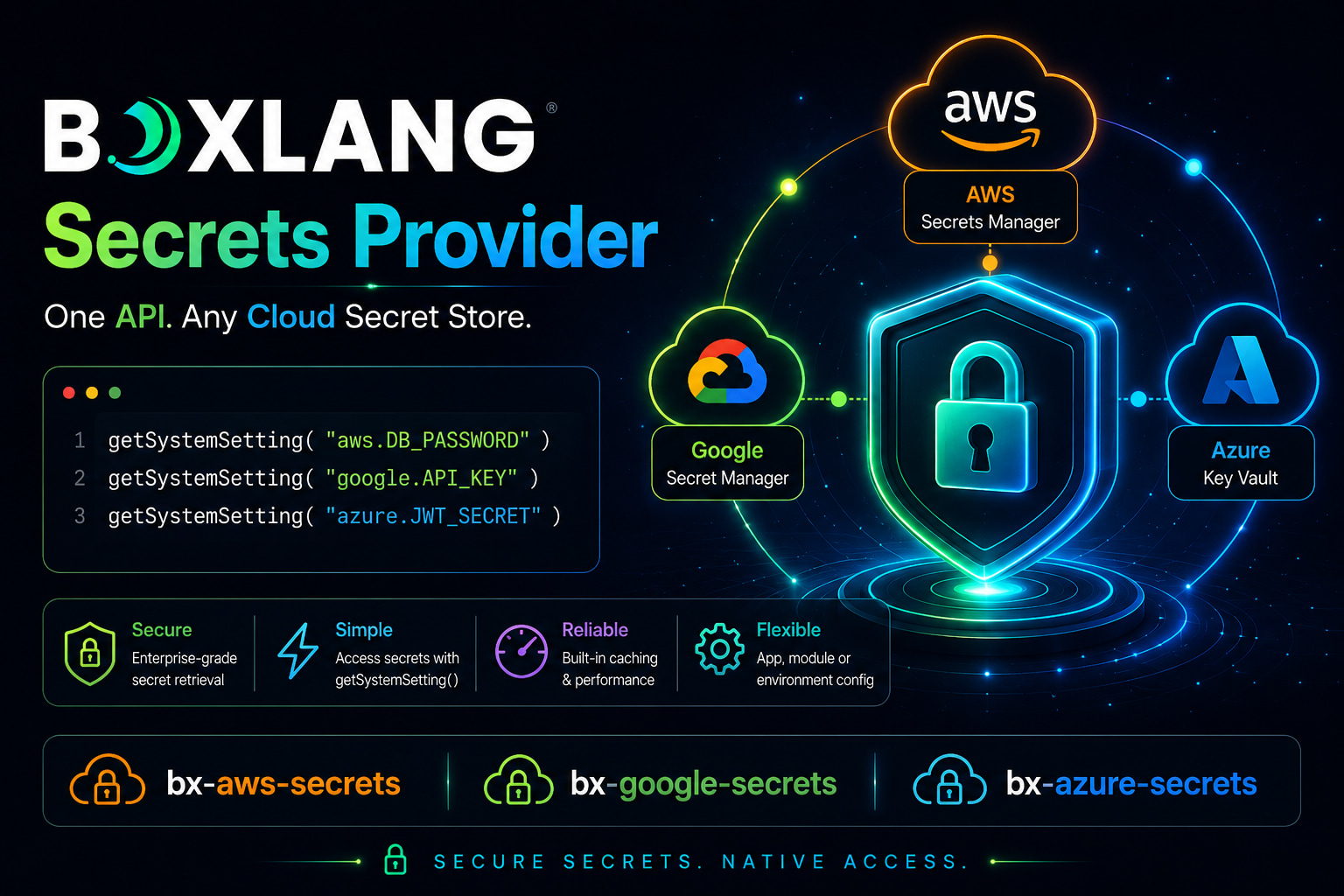
Every production application carries secrets: database passwords, API tokens, encryption keys. The question is never whether to manage them -- it's how badly the current approach is going to hurt you.
Blog
 Jacob Beers | June
15,
2026
Jacob Beers | June
15,
2026
MatchBox Brings BoxLang to ESP32 Microcontrollers 🦀
One of the most unusual parts of MatchBox is the ESP32 target.
The MatchBox open beta is available at https://github.com/ortus-boxlang/matchbox, and it can compile BoxLang scripts into bytecode and deploy them to ESP32 microcontrollers. That means the same language used for scripts, native tools, web services, and browser logic can also run on a small embedded device.
BoxLang 1.14.0 : BoxLang Ranges Part 2: Teach BoxLang Your Types with `IRangeable`
 Luis Majano |
June
15,
2026
Luis Majano |
June
15,
2026
In Part 1, we covered BoxLang's first-class range system: lazy evaluation, exclusive boundaries, built-in types (integers, decimals, characters, dates), custom stepping, Java Stream integration, and contains() semantics. If you haven't read it yet, start there.
BoxLang 1.14.0 : BoxLang Ranges Part 1: First-Class Intervals, Zero Compromises
Luis Majano |
June
11,
2026
There is a moment in every language's evolution when a convenience syntax grows up and becomes something worth thinking about. For BoxLang, that moment arrived with ranges. We had always wanted to be able to do this in our CFML apps, and we finally can
BoxLang 1.14.0 : Local Template Classes - Define Classes Right Where You Need Them
Luis Majano |
June
10,
2026
BoxLang 1.14 ships with one of the most developer-friendly OOP features we've built yet: local template classes. If you've ever created a throwaway .bx file just to hold a five-line helper class, this one's for you.
MatchBox and WebAssembly: Running BoxLang in the Browser and at the Edge
Jacob Beers |
June
04,
2026
The MatchBox open beta is live at https://boxlang.ortusbooks.com/boxlang-framework/matchbox, and it brings something genuinely new to the BoxLang ecosystem: a path into WebAssembly.
That means BoxLang code can now move into browser applications, static-site deployments, edge runtimes, and WASI-style containers - without requiring a JVM. The feature is still beta, but the core direction is already useful: write BoxLang, compile it with MatchBox, and ship the generated WASM artifact to wherever a small portable runtime makes sense.
One Language, Every Runtime: BoxLang Expands Beyond the Server
 Maria Jose Herrera |
June
04,
2026
Maria Jose Herrera |
June
04,
2026
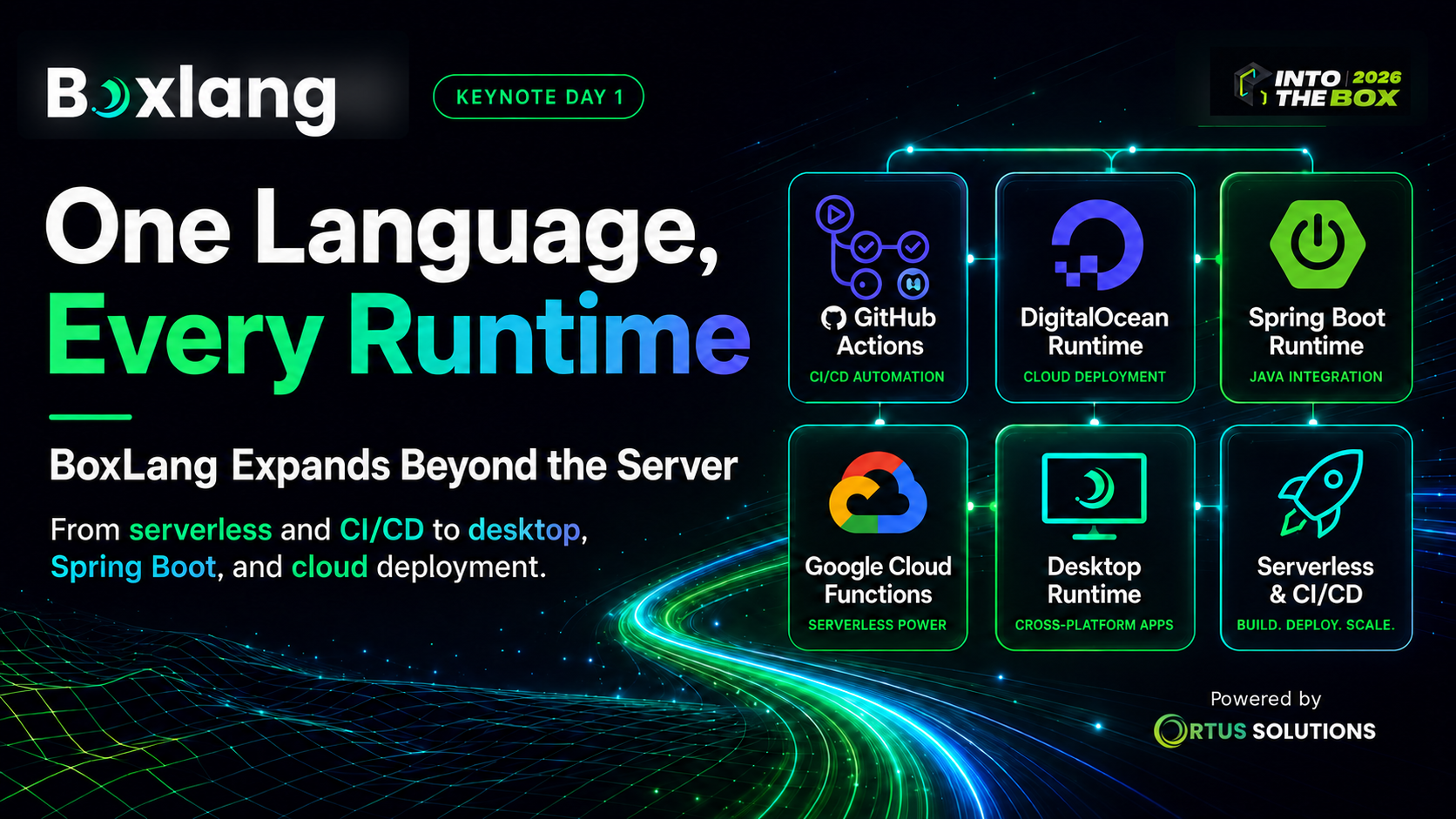
Discover how BoxLang’s multi-runtime architecture helps developers build beyond the server with support for serverless functions, desktop applications, CI/CD workflows, Java integrations, containers, runtime management, and more.
BoxLang 1.14.0 : Navigate Anything: JSONPath Comes to BoxLang's DataNavigator
Luis Majano |
June
03,
2026
Every application eventually has to deal with deeply nested data. JSON API responses with payloads six levels deep. Configuration files where the key you need is buried inside an array of objects, one of which has a null for the field you thought was required. Module metadata structures that nobody wrote a schema for. Runtime introspection data shaped like a tree that grew without a plan.
BoxLang 1.14.0 : Introducing Inner Classes
Luis Majano |
June
03,
2026
BoxLang has always embraced a simple truth: the way you organize code shapes the way you think about problems. For a long time, if you needed a helper class, you needed a file. One class, one .bx file, no exceptions. That's clean and predictable, but it creates real friction when a class is tightly coupled to exactly one caller and has no business existing anywhere else.
BoxLang 1.14.0 : Query Transformers: Take Full Control of Your Query Results
Luis Majano |
June
03,
2026
BoxLang 1.14.0 ships a lot of exciting features -- Dynamic Sets, Ranges, Inner Classes, JSONPath navigation -- but one quietly powerful addition will change the way you think about every database call in your application: Query Transformers.