Category Selected:

releases

Blog

Assert Like You Mean It, TestBox 7.1 Part 3: Data Navigator

Luis Majano |  September 29, 2026

Almost every application eventually tests a nested piece of data: an API response, a JSON config file, a serialized object, module metadata. The data is a struct that contains an array that contains structs that contain more structs, and the thing you actually care about is one value buried at the bottom.

This post has two halves. First we look at BoxLang's Data Navigator, the language feature that makes nested data pleasant to work with. Then we look at the six TestBox 7.1 expectations built on top of it. If you have never used dataNavigate(), start at the top. If you already know it, skip to The six expectations.
Read More

Assert Like You Mean It, TestBox 7.1 Part 2: Range Expectations

Luis Majano |  September 24, 2026

Before exploring the 14 range matchers, let’s take a closer look at the BoxLang Range itself. Ranges go well beyond the familiar .. syntax, providing a powerful and flexible foundation for working with sequences and boundaries. Understanding how ranges work makes the matcher API much easier to use and reason about. If you are coming from a CFML background, then this will be brand new to you as ranges have never existed until Boxlang.

Read More

Assert Like You Mean It, TestBox 7.1 Part 1: Set Expectations

Luis Majano |  September 23, 2026

If you have ever tested that two collections contain "the same stuff, order doesn't matter," you already know the workaround: sort both arrays, compare them element by element, and hope nobody adds a duplicate. It works, but it isn't what you meant to write. You meant "these are the same set."

Read More

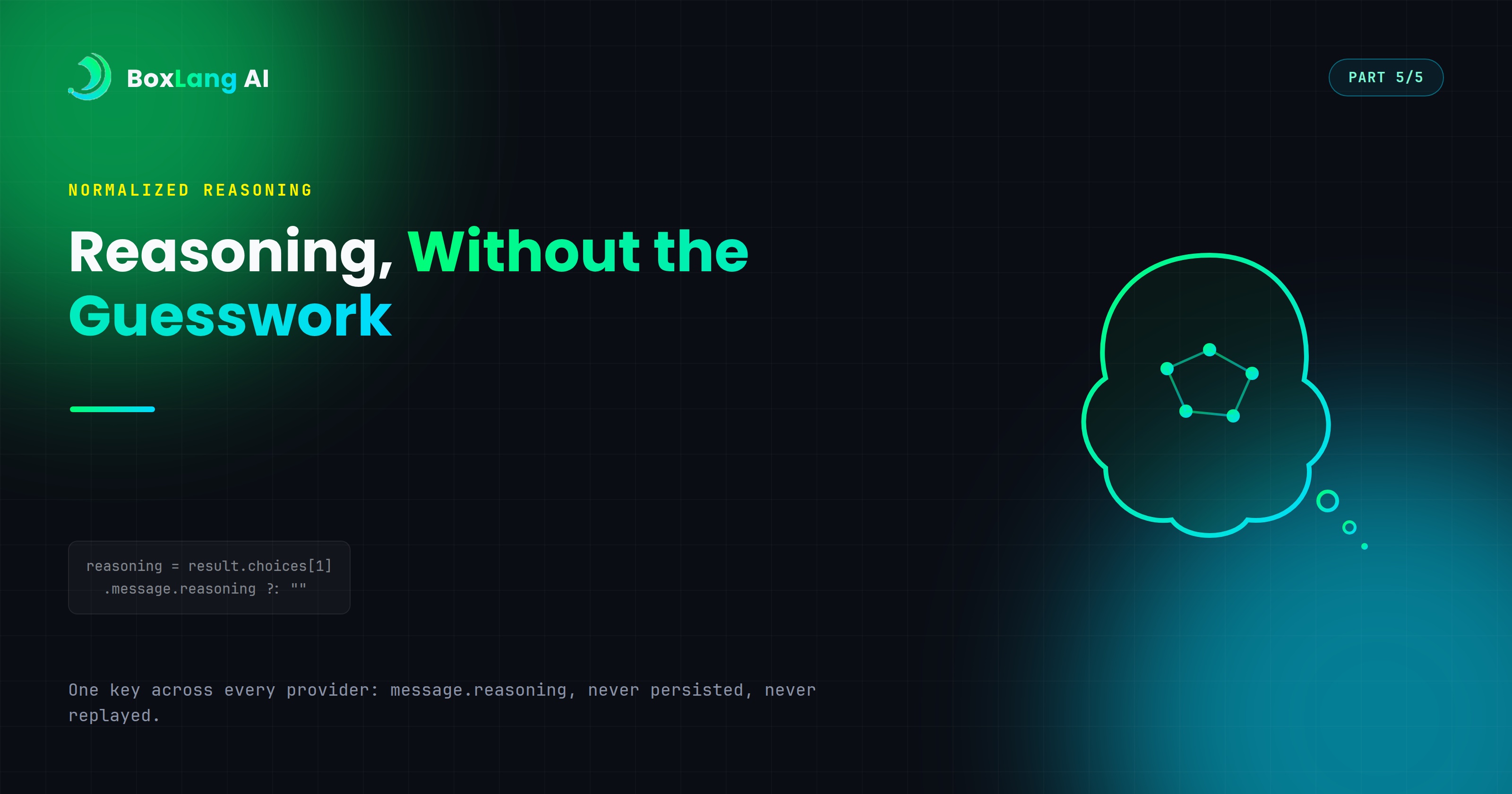
Copy of BoxLang AI 3.4 Blog Series Part 5 : Reasoning Without the Guesswork

Luis Majano |  September 15, 2026

Reasoning-capable models have been usable in BoxLang AI for a while. params passes straight through to the provider body, so params: { thinking: { type: "enabled", budget_tokens: 10000 } } for Claude, or params: { reasoning_effort: "high" } for OpenAI, already reached the API. What never worked was reading the reasoning back. It was parsed out on arrival and silently dropped. In 3.4.0, that's fixed, and it's fixed the same way for every provider.

Read More

TestBox 7.1 Released : 47 New Ways to Assert, 29 of Them BoxLang-Only

Luis Majano |  September 11, 2026

TestBox 7.1.0 is here, and it is the largest single expansion of our assertion and expectation library since TestBox was born.

Read More

BoxLang 1.17 Series Part 4 : WriteDump Enhanced!

Luis Majano |  September 11, 2026

You call writeDump() on an ORM entity or a very rich class graph . The browser locks up. Thirty seconds later you get a page with forty thousand rows on it, you scroll for a while, you give up, and you go edit your code to dump a sub-key instead. Or worse, you crash the server.

Read More

BoxLang AI 3.4 Blog Series Part 4 : Locking Down Prompt Injection

Luis Majano |  September 11, 2026

LLM applications face a class of attack traditional input validation was never built for: prompt injection. An attacker embeds instructions in user input, a retrieved document, a web page your tool fetched, or an MCP result, trying to override your system prompt, exfiltrate data, or hijack a tool call. BoxLang AI 3.4.0 ships four layered, configurable defenses against exactly this, plus one more that's on unconditionally.

Read More

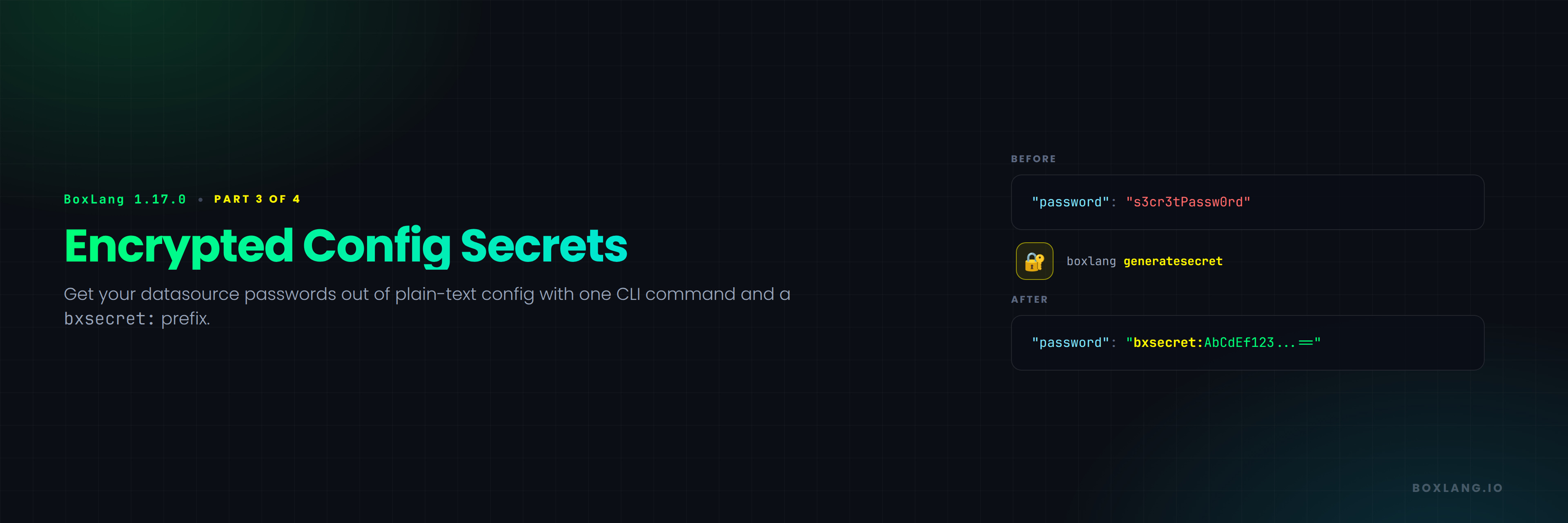
BoxLang 1.17 Series Part 3 : Encrypted Config Secrets

Luis Majano |  September 08, 2026

Everyone knows the datasource password should not be sitting in plain text in a config file. Everyone has also, at some point, shipped exactly that, because the alternative was a pile of environment variable plumbing that nobody wanted to build on a deadline. x

Read More

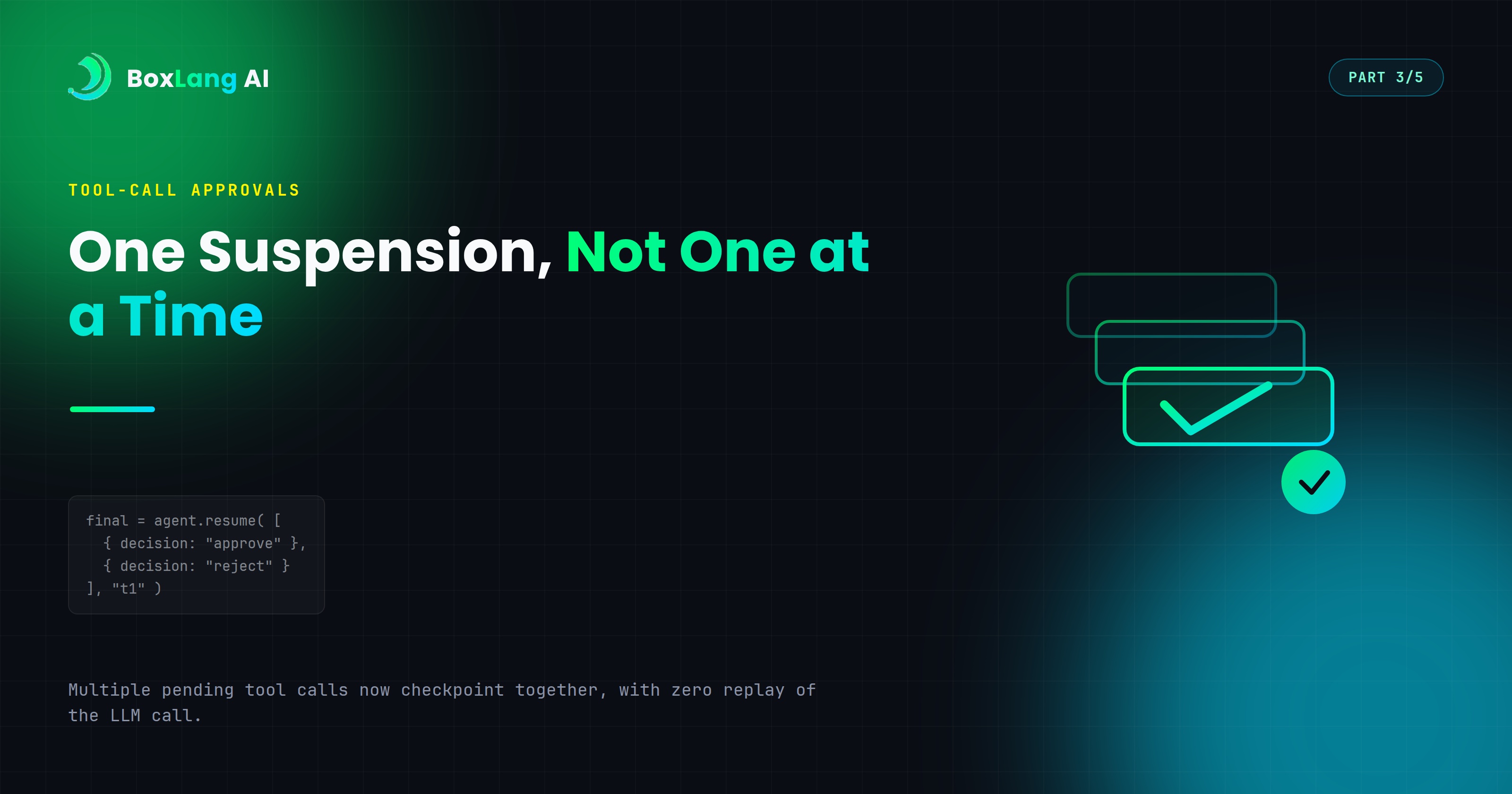
BoxLang AI 3.4 Blog Series Part 3 : Batched Approvals

Luis Majano |  September 08, 2026

Here's a bug that's easy to miss until it bites someone in production: an agent turn asks for two tool calls at once, both need human approval, and only the first one actually suspends. The second one gets silently skipped. Not rejected, not queued, just gone. That's what happened before 3.4.0, and it's fixed now with batched tool-call approvals.

Read More

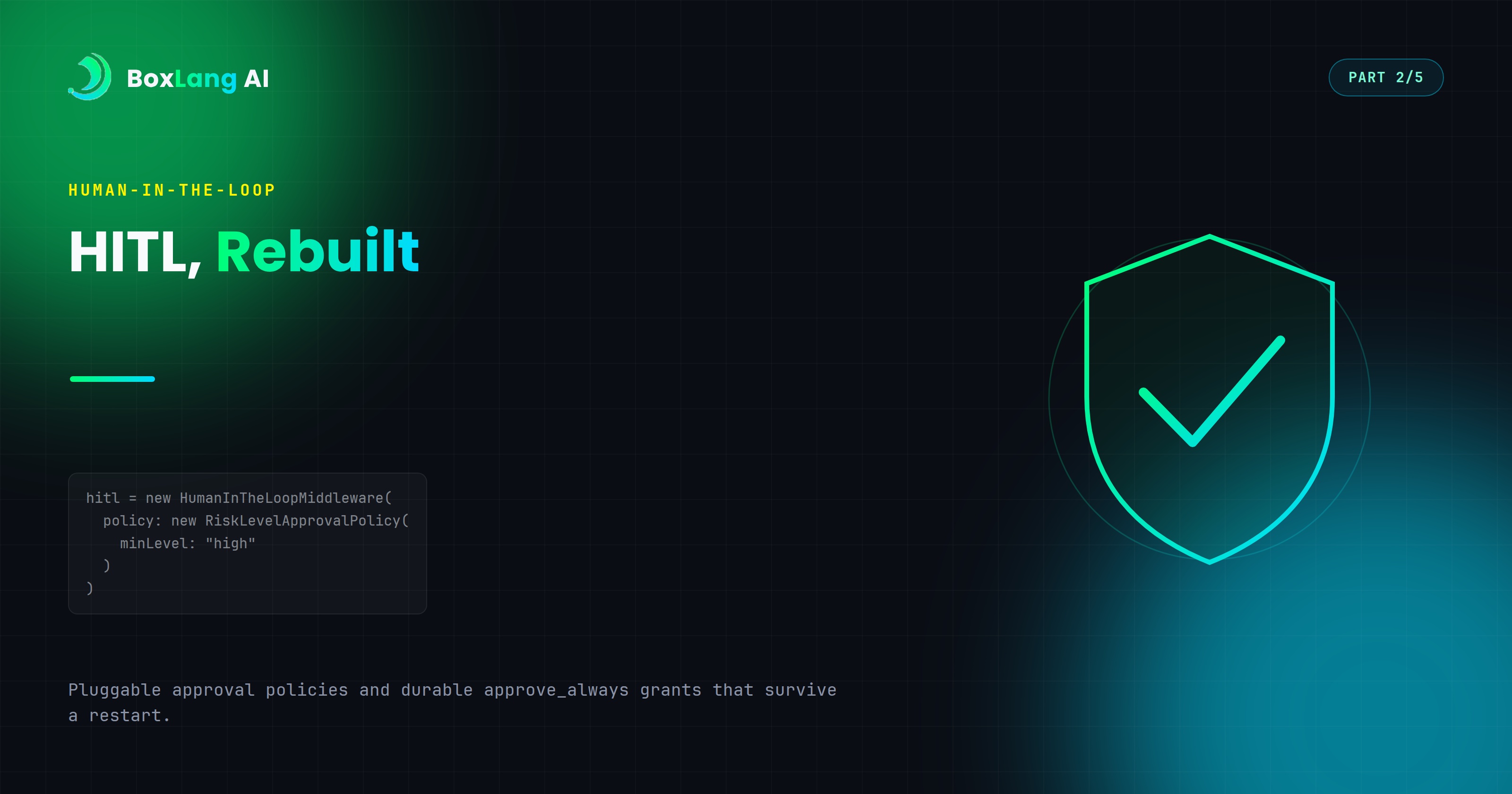
BoxLang 3.4 Blog Series Part 2: Revamped Human in The Loop HITL

Luis Majano |  September 05, 2026

HumanInTheLoopMiddleware used to do everything itself: decide which tool calls needed approval, present the request, and wait for a decision. In 3.4.0, that logic has been pulled apart into a real subsystem, and the piece developers will feel the most is that a human's "always allow this" now actually means always.

Read More