
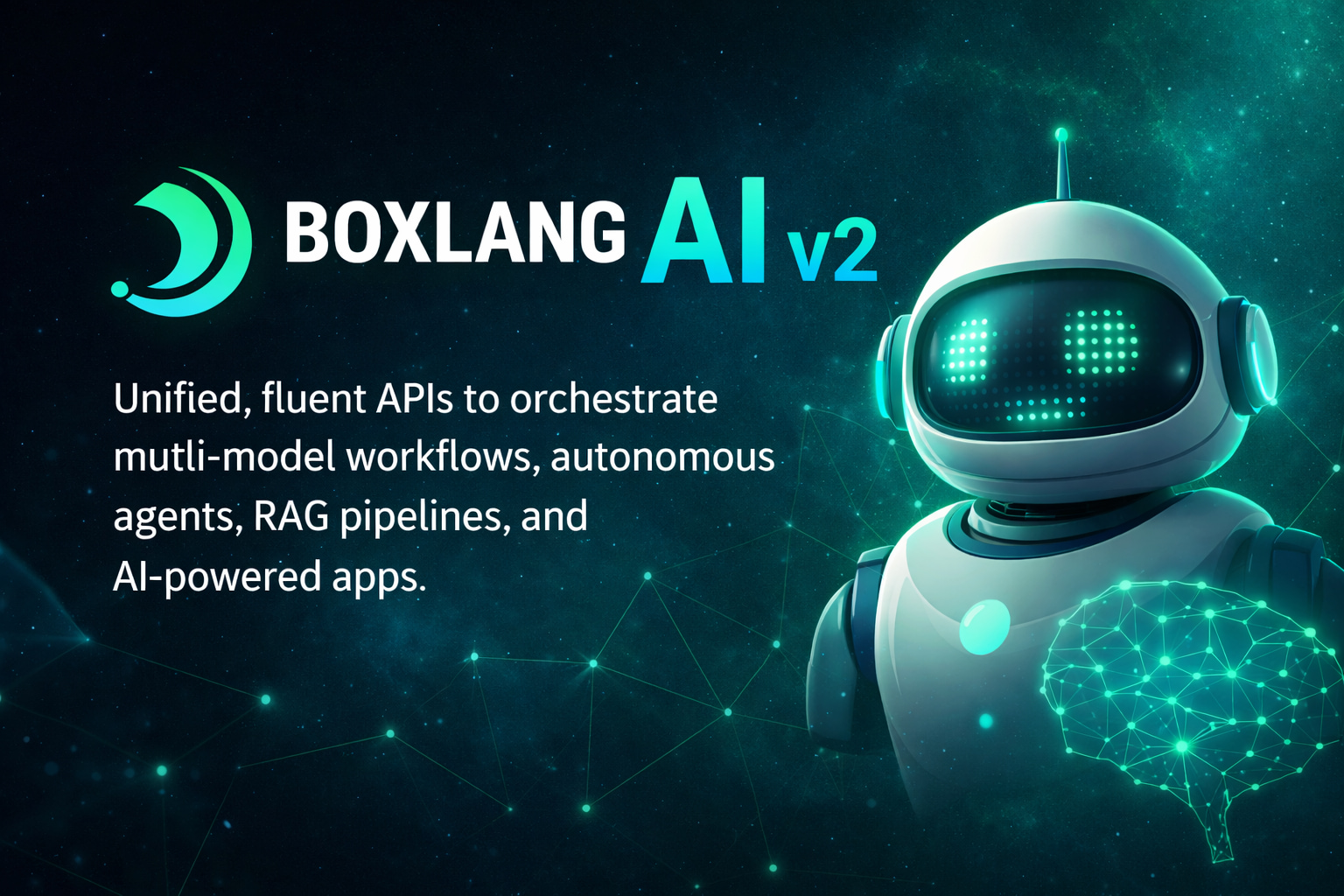
One Year. 100+ Features. Unlimited Possibilities.
Just one year ago, in March 2024, we launched BoxLang AI 1.0. Today, we're thrilled to announce BoxLang AI v2—a massive leap forward that positions BoxLang as one of the most powerful and versatile AI framework on the JVM. This release is 9-months in the making, with over 100 new features! This would have not been possible without all the new features that the BoxLang JVM language exposes to developers like: Server Side Events, HTTP Streaming, HTTP pooling, Caching, and so much more.
What Makes This Release Groundbreaking?
BoxLang AI v2 isn't an incremental update—it's a complete transformation. We've added over 100 new features that make building production-grade AI applications faster, simpler, and more powerful than ever.
🎯 Summary
BoxLang AI v2 delivers a complete AI platform with unprecedented capabilities:
- 🔌 12+ AI Providers - Single unified API for OpenAI, Claude, Gemini, Grok, Ollama, DeepSeek, Groq, Mistral, Cohere, Perplexity, OpenRouter, and HuggingFace
- 🤖 Autonomous AI Agents - Build agents with memory, tools, sub-agents, and multi-step reasoning
- 🔒 Multi-Tenant Memory Systems - Enterprise-grade isolation with 20+ memory types (standard + vector)
- 🧬 Vector Memory & RAG - 10+ vector databases with semantic search and retrieval
- 📚 Document Loaders - Process 30+ file formats including PDF, Word, CSV, JSON, XML, databases, and web scraping
- 🛠️ Real-Time Function Calling - Agents can call APIs, query databases, and integrate with external systems
- 🌊 Streaming Support - Real-time token streaming through composable pipelines
- 📦 Native Structured Output - Type-safe responses using BoxLang classes, structs, or JSON schemas
- 🔗 AI Pipelines - Build composable workflows with models, transformers, and custom logic
- 📡 MCP Protocol - Build and consume Model Context Protocol servers, integrate with ANY MCP-compatible system
- 💬 Fluent Interface - Chainable, expressive syntax across all components
- 🦙 Local AI - Complete Ollama support for privacy, offline use, and zero API costs
- ⚡ Async Operations - Non-blocking futures for concurrent AI requests
- 🎯 Event-Driven Architecture - 25+ lifecycle events for logging, monitoring, and custom workflows
- 🏭 Production-Ready - Timeout controls, error handling, rate limiting, retries, and debugging tools
- ☁️ Serverless Deployment - Deploy AI agents on AWS Lambda with the BoxLang AWS Runtime
- ⏰ Autonomous Scheduling - Create self-running agents on any OS with BoxLang Scheduler
This release transforms BoxLang into the most comprehensive AI development platform available, with zero vendor lock-in and production-grade reliability.
🤖 Autonomous AI Agents
Build intelligent agents that think, remember, and act independently. Agents are the crown jewel of BoxLang AI v2—capable of multi-step reasoning, tool usage, memory management, and delegation.
// Create an agent with multiple memories, tools, and sub-agents
agent = aiAgent(
    name: "Support Bot",
    instructions: "You are a helpful customer support agent",
    memory: [
        aiMemory( "vector", { provider: "chromadb" } ),      // Semantic search
        aiMemory( "cache", { cacheName: "sessions" } ),       // Session history
        aiMemory( "conversation" )                            // Current context
    ],
    tools: [
        customerLookupTool,
        ticketSystemTool,
        inventoryCheckTool,
        MCP( "http://crm-server:3000" )                      // External MCP tools
    ],
    subAgents: [
        technicalSupportAgent,                                // Delegate technical issues
        billingAgent                                          // Delegate billing questions
    ],
    model: aiModel( "claude", { model: "claude-sonnet-4.5" } )
);

// Agent orchestrates everything automatically
response = agent.run( "Find John's order, check inventory, and update shipping" );
Agent Capabilities:
- Multiple Memories - Combine vector, cache, conversation, and database memories
- Multiple Tools - Integrate APIs, databases, MCP servers, and custom functions
- Sub-Agents - Delegate specialized tasks to other agents
- Multi-Step Reasoning - Break down complex requests automatically
- Context Awareness - Maintain conversation history across sessions
- Error Handling - Automatic retry logic and graceful degradation
⚡ Serverless AI Agents on AWS Lambda
Deploy AI agents as serverless functions using the BoxLang AWS Runtime:
// Lambda handler with AI agent
function handler( event, context ) {
    agent = aiAgent(
        name: "Invoice Processor",
        memory: aiMemory( "dynamodb" ),
        model: aiModel( "openai" )
    );

    return agent.run( event.query );
}
Benefits:
- Zero server management
- Pay per invocation
- Auto-scaling
- Enterprise-grade reliability
Get started with our AWS Lambda Starter Template.
🔄 Autonomous Agents with BoxLang Scheduler
Create truly autonomous agents that run on schedules—no servers required:
// Autonomous monitoring agent
class {
    function configure() {
		systemAgent = aiAgent(
			name: "System Monitor",
			instructions: "Analyze system metrics and alert on anomalies",
			tools: [ metricsAPI, slackNotifier ],
			model: aiModel( "grok" )
		)

        scheduler.task( "Monitor System" )
            .call( () => {
                systemAgent.run( "Check system health and notify if issues found" )
            })
            .everyHour()
    }
}
Deploy autonomous agents on any OS with the BoxLang Scheduler.
🧬 Multi-Tenant Vector Memory & RAG
Enterprise-grade isolation with 10+ vector databases:
// User-specific RAG memory
memory = aiMemory(
    "vector",
    userId: "alice",
    conversationId: createUUID(),
    config: {
        provider: "pinecone",
        embeddingModel: "text-embedding-3-large"
    }
);

agent = aiAgent(
    name: "RAG Assistant",
    memory: memory,
    model: aiModel( "gemini" )
);

// Agent automatically retrieves relevant context
response = agent.run( "What did we discuss about Q4 projections?" );
Supported Vector DBs: ChromaDB, Pinecone, PostgreSQL+pgvector, Weaviate, Qdrant, Milvus, and more.
📚 Document Loaders for 30+ Formats
Load and process documents from any source:
// Load and embed documents directly to memory stores

// Single memory ingestion
result = aiDocuments( "/docs", { type: "markdown" } )
    .toMemory( myVectorMemory )

// With chunking options
result = aiDocuments( "/knowledge-base" )
    .recursive()
    .extensions( [ "md", "txt" ] )
    .toMemory( myVectorMemory, { chunkSize: 500, overlap: 50 } )

// Multi-memory fan-out (async supported)
result = aiDocuments( "/docs", { type: "markdown" } )
    .toMemory( [ chromaMemory, pgVectorMemory ], { async: true } )
Supported formats: PDF, Word, CSV, JSON, XML, Excel, Markdown, HTML, databases, web scraping, and more.
🔌 12+ AI Provider Support
One API for all major providers:
// Switch providers with zero code changes
response = aiChat(
    "Explain quantum computing",
    { model: "gpt-4o" },
    { provider: "openai" }
);

// Same code, different provider
response = aiChat(
    "Explain quantum computing",
    { model: "claude-sonnet-4.5" },
    { provider: "claude" }
);
Providers: OpenAI, Claude, Gemini, Grok, Groq, DeepSeek, Ollama, Mistral, Cohere, Perplexity, OpenRouter, HuggingFace.
📡 Model Context Protocol (MCP)
Full MCP support for building distributed AI systems. Create your own MCP servers or integrate with ANY external MCP-compatible system using the fluent MCP() function.
Build MCP Servers:
// Create and expose your own MCP server
server = mcpServer(
    name: "analytics",
    description: "Business Analytics MCP Server",
    version: "1.0.0"
)
    .addTool( salesDataTool )
    .addTool( reportGeneratorTool )
    .addTool( forecastingTool )
    .start();
Consume ANY MCP Server:
// Integrate with external MCP servers using fluent MCP()
agent = aiAgent(
    name: "Enterprise Assistant",
    tools: [
        MCP( "http://crm-system:3000" ),          // CRM tools
        MCP( "http://analytics:3001" ),           // Analytics tools
        MCP( "http://inventory:3002" ),           // Inventory tools
        localCustomTool                            // Mix with local tools
    ],
    model: aiModel( "claude" )
);

// Agent can use tools from multiple MCP servers
response = agent.run( "Get Q4 sales from CRM and create forecast report" );
Multiple MCP Servers:
// Connect to multiple MCP servers simultaneously
pipeline = aiModel( "grok" )
    .withTools([
        MCP( "https://github-mcp.com" ),
        MCP( "https://slack-mcp.com" ),
        MCP( "https://jira-mcp.com" )
    ])
    .invoke( "Create GitHub issue, notify in Slack, and update Jira ticket" );
MCP Features:
- Build custom MCP servers to expose your tools
- Consume external MCP servers with
MCP()fluent function - Connect to multiple MCP servers simultaneously
- Mix MCP tools with local function tools
- Full protocol compliance for interoperability
📦 Native Structured Output
Get type-safe, validated responses directly from AI models. No more parsing JSON strings or handling malformed responses.
// Define your BoxLang class
class Invoice {
    property name="invoiceNumber";
    property name="date";
    property name="total";
    property name="items" type="array";
}

// Get structured output directly
invoice = aiChat(
    "Extract invoice data from this receipt: ...",
    {
        model: "gpt-4o",
        response_format: { type: "json_schema", schema: Invoice }
    }
);

// Type-safe access
println( invoice.getInvoiceNumber() );
println( invoice.getTotal() );
Structured Output Options:
- BoxLang classes with properties
- Struct schemas
- JSON schema definitions
- Array responses
- Nested complex objects
🌊 Streaming Support
Real-time token streaming for responsive applications thanks to BoxLang:
// Stream responses as they generate
aiChatStream(
    "Write a detailed technical article",
    ( chunk ) => {
        print( chunk );  // Display tokens as they arrive
        flush();
    },
    { model: "claude-sonnet-4.5" }
);

// Stream through pipelines
pipeline = aiModel( "openai" )
    .pipe( transformerA )
    .pipe( transformerB )
    .stream(
        input,
        ( token ) => handleStreamToken( token )
    );
⚡ Async Operations
Non-blocking futures for concurrent AI requests:
// Execute multiple AI requests concurrently
future1 = aiChatAsync( "Analyze customer sentiment", { provider: "openai" } );
future2 = aiChatAsync( "Generate product description", { provider: "claude" } );
future3 = aiChatAsync( "Translate to Spanish", { provider: "gemini" } );

// Wait for all to complete
results = [
    future1.get(),
    future2.get(),
    future3.get()
];

// Or use fluent combinators
future1.thenApply( ( result ) => processResult( result ) )
    .thenCompose( ( data ) => aiChatAsync( "Summarize: " & data ) )
    .thenAccept( ( summary ) => println( summary ) );
🔗 AI Pipelines
Build composable workflows with models, transformers, and custom logic:
// Complex multi-step pipeline
pipeline = aiDocuments( pdfFiles )
    .load()
    .chunk( maxSize: 1000 )
    .embed( provider: "openai" )
    .pipe( aiModel( "claude" ) )
    .pipe( aiTransform( "extract-json" ) )
    .pipe( aiTransform( "validate" ) )
    .pipe( ( data ) => {
        saveToDatabase( data );
        return data;
    });

result = pipeline.invoke( inputData );
Pipeline Features:
- Chain multiple AI models
- Add custom transformers
- Inject business logic
- Handle errors gracefully
- Monitor execution time
🎯 Event-Driven Architecture
25+ lifecycle events for observability and control:
// Listen to AI events
interceptorService.listen( "onAIRequest", ( data ) => {
    logger.info( "AI Request to #data.provider#" );
    recordMetrics( data );
});

interceptorService.listen( "onAITokenCount", ( data ) => {
    trackCosts(
        provider: data.provider,
        tokens: data.totalTokens
    );
});

interceptorService.listen( "onAIError", ( data ) => {
    if( data.canRetry ) {
        scheduleRetry( data );
    } else {
        alertOps( data.error );
    }
});
Available Events:
- Request/Response lifecycle
- Token usage tracking
- Error handling
- Agent creation and execution
- Tool execution
- Memory operations
- Rate limit detection
- Model invocation
- Pipeline execution
🏭 Production-Ready Features
Built for enterprise deployment:
Timeout Controls:
response = aiChat(
    messages,
    {},
    { timeout: 30000 }  // 30 second timeout
);
Error Handling:
try {
    result = agent.run( input );
} catch( AIProviderException e ) {
    // Handle rate limits, timeouts, etc.
    fallbackResult = useBackupProvider();
}
Rate Limiting:
// Automatic rate limit detection and retry
interceptorService.listen( "onAIRateLimitHit", ( data ) => {
    waitTime = data.retryAfter ?: 60;
    sleep( waitTime * 1000 );
    retry( data.provider );
});
Debugging:
// Comprehensive logging
response = aiChat(
    messages,
    {},
    {
        logRequest: true,
        logResponse: true,
        logRequestToConsole: true
    }
);
🦙 Local AI with Ollama
Zero API costs, complete privacy, offline capability:
// Run AI completely locally
agent = aiAgent(
    name: "Private Assistant",
    model: aiModel( "ollama", {
        model: "llama3.2",
        chatURL: "http://localhost:11434"
    })
);

// No internet required, no API keys, no costs
response = agent.run( "Analyze this confidential document" );
Local AI Benefits:
- Zero API costs
- Complete data privacy
- Offline operation
- No rate limits
- Full control
🎯 Real-World Use Cases
Customer Support Automation:
agent = aiAgent(
    name: "Support Agent",
    memory: aiMemory( "cache" ),
    tools: [ zenDeskAPI, slackNotifier ],
    model: aiModel( "claude", { model: "claude-sonnet-4.5" } )
);
Data Analysis Pipeline:
pipeline = aiModel( "openai" )
    .pipe( aiTransform( "extract-json" ) )
    .pipe( aiTransform( "validate" ) )
    .pipe( ( data ) => saveToDatabase( data ) );

result = pipeline.invoke( csvData );
Scheduled Report Generation:
scheduler.task( "Weekly Report" )
    .call( () => {
        agent = aiAgent(
            name: "Report Generator",
            model: aiModel( "gemini" )
        );
        report = agent.run( "Generate weekly sales report" );
        sendEmail( report );
    })
    .onMondays()
    .at( "09:00" );
📖 Comprehensive Learning Resources
We've built a complete ecosystem to help you master BoxLang AI:
🌐 Official Website
ai.boxlang.io - Features, examples, and quickstart guides
📚 Complete Documentation
ai.ortusbooks.com - Full API reference and guides
🎓 Free AI Bootcamp
BoxLang AI Bootcamp - Hands-on training from basics to advanced
💻 60+ Code Examples
Examples Gallery - Real-world implementations
🏢 Professional Services
ai.ortussolutions.com - Enterprise consulting and support
🚀 Getting Started
OS Applications
install-bx-module bx-ai
AWS Lambda
cd src/resources
install-bx-module bx-ai --local
Web Applications
box install bx-ai
Your First Agent
agent = aiAgent(
    name: "Assistant",
    instructions: "You are a helpful AI assistant",
    model: aiModel( "openai" )
);

response = agent.run( "How do I use BoxLang AI?" );
println( response );
Why BoxLang AI v2 Matters
For Developers:
- One fluent API for all AI providers
- No vendor lock-in
- Production-ready with timeouts, retries, and error handling
- Local AI support with Ollama (zero API costs)
For Enterprises:
- Multi-tenant isolation
- Enterprise-grade memory systems
- Serverless deployment options
- Professional support available
For the Ecosystem:
- 100% open source (Apache 2)
- Active community
- Extensive documentation
- Real-world examples
The Year Ahead
In just 12 months, we've transformed BoxLang AI from a simple chat wrapper into a comprehensive AI platform. But we're not stopping here.
With v2, you can:
- Build autonomous agents that work 24/7
- Deploy serverless AI functions globally
- Create RAG systems with semantic search
- Integrate 12+ AI providers seamlessly
- Process 30+ document formats
- Build MCP-compatible tools
What's coming:
- Guardrails System
- Agent hooks
- Runnable Middleware
- Observability
- Auditing
- More vector databases
- More cowbell 🐄 🔔
The future of AI development is here. It's written in BoxLang.
Get Started Today
- Documentation: ai.ortusbooks.com
- Website: ai.boxlang.io
- Bootcamp: github.com/ortus-boxlang/bx-ai/bootcamp
- Examples: github.com/ortus-boxlang/bx-ai/examples
- Professional Services: ai.ortussolutions.com
Join our community and help shape the future of AI on the JVM!


Add Your Comment