
BoxLang has always been an extensible language. As of 1.17.0, it is a hierarchically extensible one.
Modules can now contain other modules; aka Module Inception. Recursively. To any depth. Each nested module gets its own class loader, chained to its parent's, and BoxLang's own ModuleService discovers, registers, activates, and unloads that entire tree itself. No package manager. No build tool. No install ordering. Drop in one artifact and everything it depends on comes with it, already wired up and already isolated. Not only that, you can now package modules into a single jar.

That is the headline, and it changes what a BoxLang module fundamentally is. A module is no longer a leaf in a flat list that something outside the language has to resolve for you. It is a tree, and the runtime owns the whole thing.
The rest of 1.17.0 is aimed squarely at the people building on top of that. boxlang check validates syntax without executing or compiling anything, and speaks JSON, which turns it into a correction signal for editors, CI pipelines, and AI agents alike. bxsecret: gets your datasource passwords out of plain-text config with a single CLI command. include and xmlParse() are hardened against whole classes of injection attack. JARs are no longer locked on Windows, so hot reload finally works the way it always should have. writeDump() gets real output control with depth and the new maxRows. And a background watchdog reclaims the hundreds of megabytes of parser cache that long-running servers used to accumulate and never release.
32 issues closed: 5 new features, 12 improvements, 15 bug fixes.
Module Inception
Every other module ecosystem you have worked in is flat. You declare a list of dependencies and something outside the language, a package manager or a build tool, resolves and downloads and orders them. The language itself has no opinion about the shape of the graph.
BoxLang 1.17.0 changes that. Drop a modules/ folder into your module, and BoxLang treats it exactly like a top-level modulesDirectory.
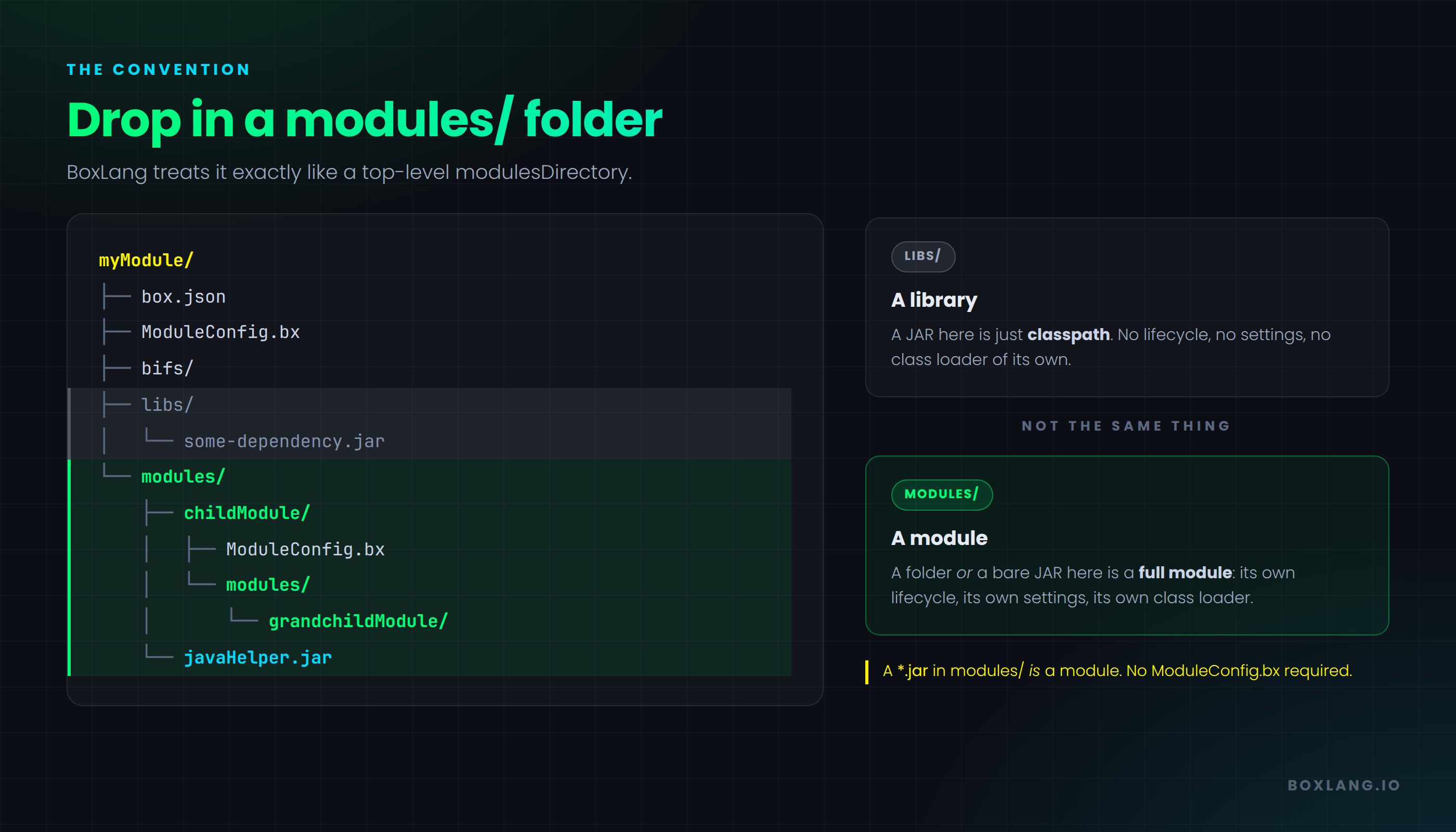
The practical outcome: one self-contained artifact, a single module folder or a single JAR, that brings every module it depends on along with it, fully isolated from the host application's own modules, working the moment it is dropped in.
The distinction that matters most is the one on the right of that diagram. libs/ and modules/ are not the same thing. A JAR in libs/ is a library added to your module's classpath. A JAR in modules/ is a module, with its own lifecycle, its own settings, and its own class loader.
Load Order
Nested modules load from the inside out and unload from the outside in.
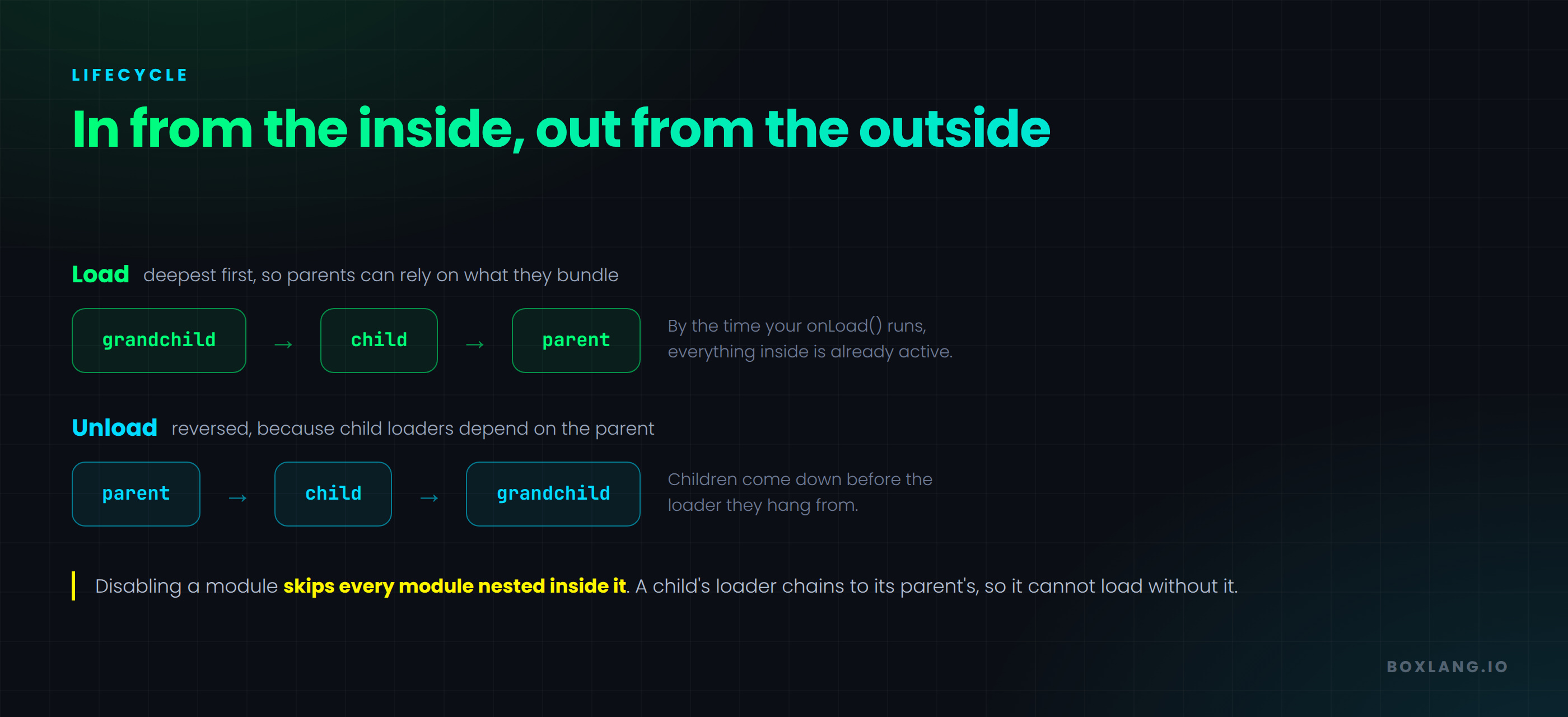
Registering or activating a parent cascades down the whole tree first, so by the time your module's onLoad() runs, everything it bundles is already active and usable. Unloading reverses it, because a child's class loader depends on its parent's.
Class Loader Chaining
Isolation here is real, not conventional. The class loader hierarchy mirrors the module hierarchy: a nested module's loader is parented to its parent module's loader, chaining upward until a top-level module, whose loader is parented to the runtime.
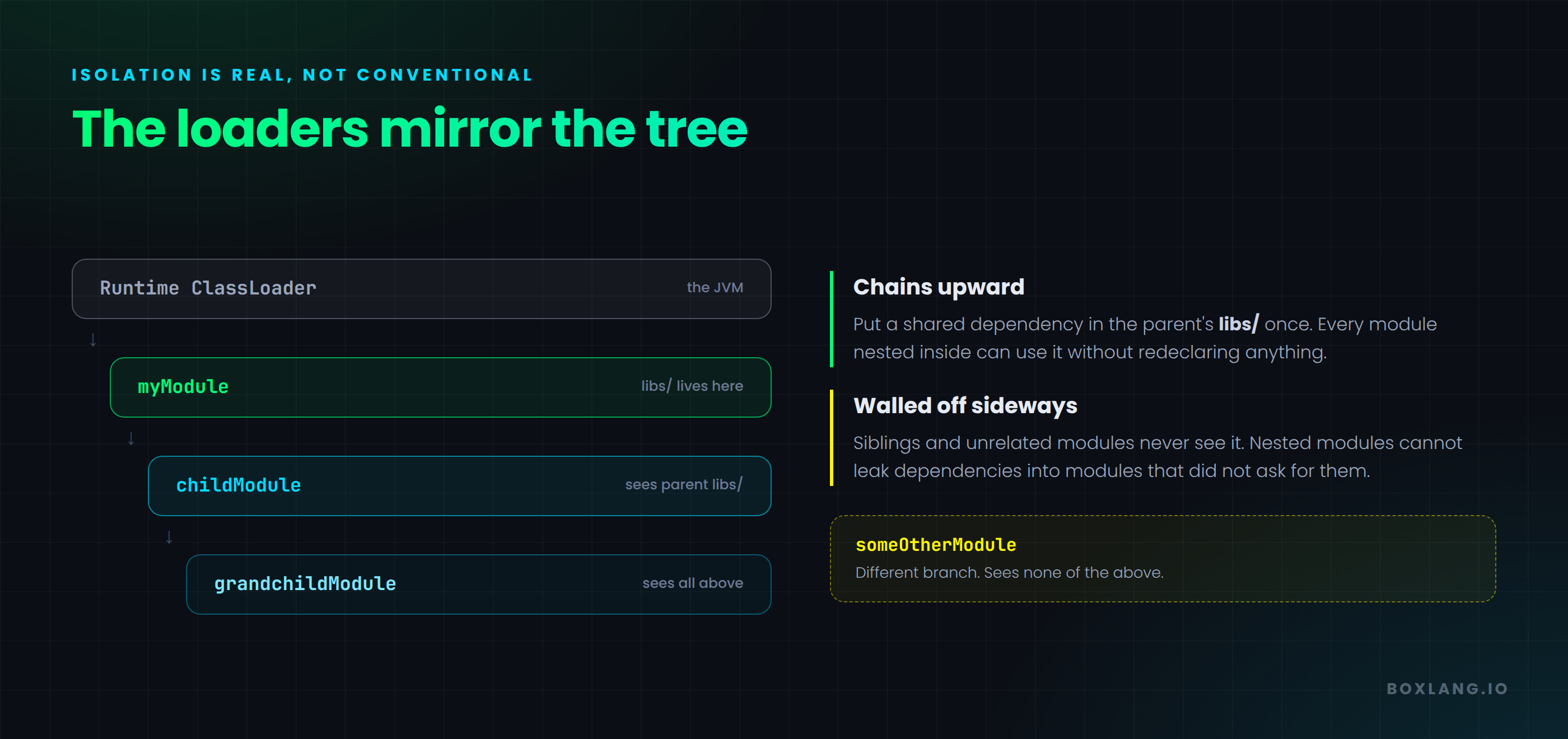
Put a shared dependency in the parent's libs/ once and every module nested inside it can use it without redeclaring anything, while remaining invisible to siblings and unrelated modules.
One implementation detail worth knowing if you are working from Java: module class loaders create a real isolation boundary, so they pass null as the standard ClassLoader parent and track the real one themselves. Walk the chain with DynamicClassLoader.getDynamicParent(), because the standard getParent() returns null for a module loader.
JAR Modules
The other half of Inception is that a bare *.jar sitting in a modules/ folder is a module. No ModuleConfig.bx, no box.json, no surrounding folder at all. Its descriptor is a Java IModuleConfig registered through META-INF/services/ortus.boxlang.runtime.modules.IModuleConfig, and its metadata comes from a @BoxModule annotation.
@BoxModule(
    name        = "javaHelper",
    version     = "1.0.0",
    author      = "Ortus Solutions",
    description = "A module shipped as a single JAR"
)
public class JavaHelperModule implements IModuleConfig {

    @Override
    public void configure( IBoxContext context, ModuleRecord moduleRecord ) {
        moduleRecord.settings.put( Key.of( "mode" ), "fast" );
    }

}
Without name, a JAR module is named after the JAR file itself, so javaHelper.jar becomes javaHelper. Declaring name lets the module name stand independent of the filename, which matters when your build stamps versions into JAR names.
A JAR that exposes no IModuleConfig is disabled with a warning rather than failing the runtime, so a stray JAR dropped into a modules folder logs a complaint instead of breaking startup.
This is what makes bundled dependencies practical. A pure-Java library your module needs can ship as a first-class module in its own right, without a .bx file anywhere in sight.
A Parent Can Override What It Bundles
Nesting a module does not mean losing control over it. A parent declares a this.modules struct mirroring the boxlang.json shape.
// myModule/ModuleConfig.bx
class {

	this.version = "1.0.0"

	/**
	 * Per-child overrides for the modules nested inside this one
	 */
	this.modules = {
		"childModule" : {
			enabled  : true,
			settings : {
				timeout  : 60,
				endpoint : "https://internal.example.com"
			}
		}
	}

}
The Java equivalent, for JAR modules:
@Override
public IStruct modules() {
    IStruct childSettings = new Struct();
    childSettings.put( Key.of( "timeout" ), 60 );
    childSettings.put( Key.of( "endpoint" ), "https://internal.example.com" );

    IStruct childOverrides = new Struct();
    childOverrides.put( Key.enabled, true );
    childOverrides.put( Key.settings, childSettings );

    IStruct overrides = new Struct();
    overrides.put( Key.of( "childModule" ), childOverrides );
    return overrides;
}
Those overrides land in the middle of a three-layer precedence chain.
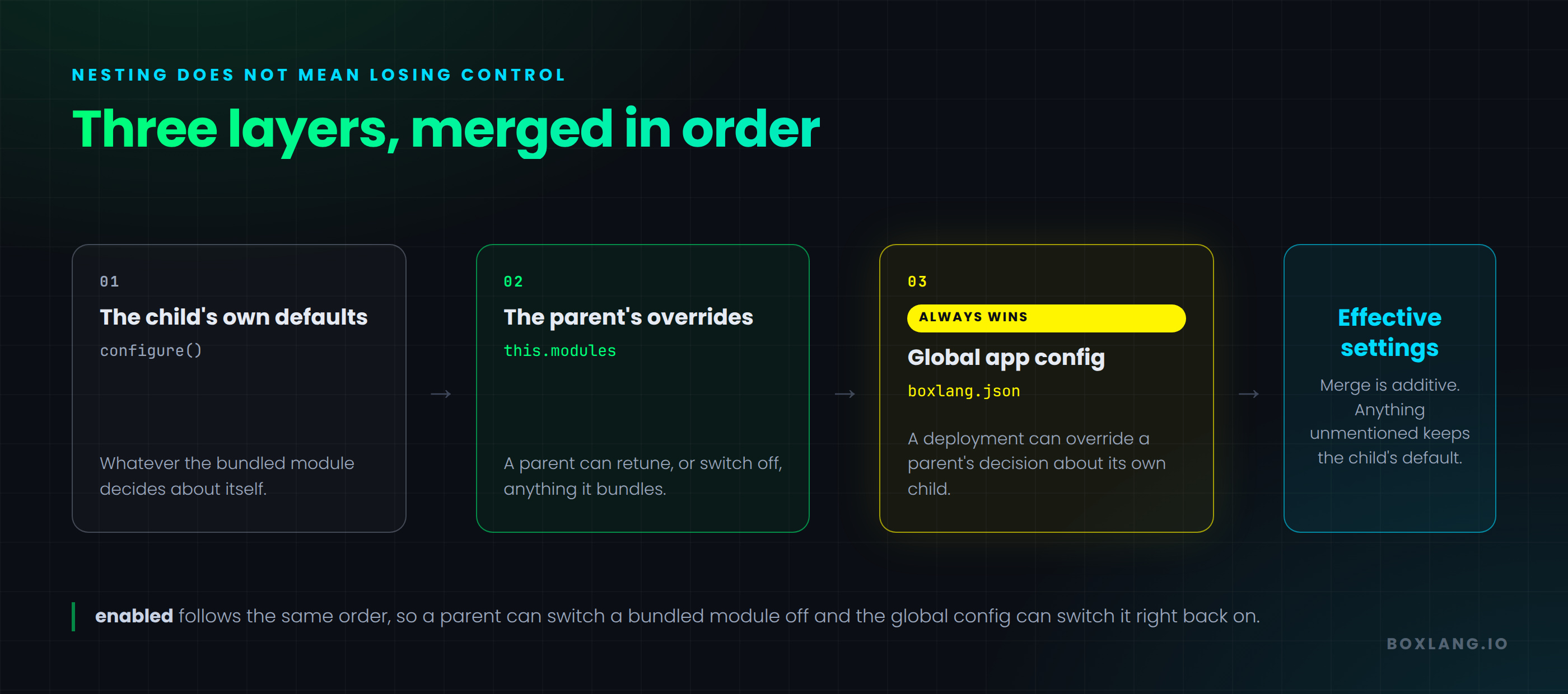
The global app config is applied last and always wins, so a deployment can override anything, including a parent's decision about its own child. The merge is additive: settings the parent does not mention keep the child's own defaults.
Walking the Tree
Nested modules live in the same flat registry as everything else, so they stay globally addressable by name and their BIFs, components, and mappings work exactly as they would at the top level. The relationship is recorded on both ModuleRecord objects, so either end can find the other.
| Member | On | Description |
|---|---|---|
nestedModules | parent | Array of names of modules nested directly inside this one |
getNestedModule( Key ) | parent | The record for one direct child, or null |
hasNestedModule( Key ) | parent | Whether a module is a direct child of this one |
parentModule | child | The Key of the module this one is nested inside, or null |
isJarModule() | either | Whether this module is packaged as a single JAR |
// From a parent module's ModuleConfig.bx
var child = moduleRecord.getNestedModule( createObject( "java", "ortus.boxlang.runtime.scopes.Key" ).of( "childModule" ) )
log.info( "Child version: #child.version#" )
To see the hierarchy from outside any one module's own code, from a script, an admin dashboard, or a debug session, the new getModuleTree() BIF returns every top-level module as a struct, and every node carries a children struct of the modules nested inside it, recursively.
tree = getModuleTree()

for ( moduleName in tree ) {
	node = tree[ moduleName ]
	writeOutput( "#moduleName# (v#node.version#)" )
	for ( childName in node.children ) {
		writeOutput( "  ↳ #childName#" )
	}
}
Pass a module name to get the subtree rooted at that module instead of the whole forest:
subtree = getModuleTree( "myModule" )
// subtree.children holds myModule's direct nested modules, each with its own .children
An unregistered module name returns an empty struct rather than throwing. Note that nested modules never appear at the top level of the result, so find them under their parent's children entry. getModuleList() and getModuleInfo() still address every module by name in one flat collection, nested or not. getModuleTree() is the one that shows the shape.
Why This Matters
Module authors no longer have to choose between one giant module that does everything and many small modules the user has to install in the right order. A module can be exactly as granular as makes sense internally while presenting as a single install to the outside world. Because the class loader isolation is real, nested modules never leak their dependencies into modules that did not ask for them.
One known limitation: shutdown ordering across unrelated modules is not dependency-aware, since unloadAll() visits the registry in unspecified order. Nesting order itself is handled, and a module's children always unload before it does.
Full documentation, including the shutdown-ordering caveat, is at Module Inception.
boxlang check: A Syntax Checker Built for Agents
The new check action command parses one or more source files and reports syntax errors without executing the code or compiling it to bytecode. It is the BoxLang equivalent of bash -n script.sh or node --check file.js.
It works across .bx, .bxs, .bxm, .cfm, .cfc, and .cfs, and because it runs on the real BL AST and the actual ANTLR parsers, results are accurate for both BoxLang and CFML source.
# One or more explicit files
boxlang check myapp.bx myComponent.cfc

# An entire directory, walked recursively
boxlang check --source ./src

# Machine-readable output
boxlang check --source ./src --format json
A valid file produces minimal output and exits 0:
$ boxlang check good.bxs
✅ good.bxs

───────────────────────────────
✅ 1 valid   ❌ 0 invalid   (1 files checked)
An invalid file reports the file, line, column, and message, and exits 1:
$ boxlang check bad.bxs
❌ bad.bxs
   bad.bxs: Line: 1 Col: 3 - Unclosed parenthesis [(] on line 1
if ( true {
   ^

───────────────────────────────
✅ 0 valid   ❌ 1 invalid   (1 files checked)
The Part That Matters for AI Agents
This is where check earns its place in this release rather than in a tooling footnote.
An LLM writing BoxLang has no reliable way to know whether what it just produced is real syntax. It will confidently emit a construct that does not parse, because a plausible-looking token sequence and a valid one are not the same thing, and nothing in the generation process distinguishes them. Without a checker in the loop, that error surfaces at runtime: in a stack trace, possibly during a test run, possibly in production, possibly never during the agent's own working session at all.
boxlang check --format json closes that loop. The agent writes a file, runs the checker, and gets back a structured array of {file, valid, issues} records with line, column, and message per issue.
[ {
  "file" : "/path/to/demo/bad.bxs",
  "valid" : false,
  "issues" : [ {
    "message" : "Unclosed parenthesis [(] on line 1\nif ( true {\n   ^",
    "line" : 1,
    "column" : 3
  } ]
}, {
  "file" : "/path/to/demo/good.bxs",
  "valid" : true,
  "issues" : [ ]
} ]
That is a machine-readable correction signal, which means an agent can repair its own hallucination before the code is ever executed. The loop is simple enough to wire into any harness:
- Generate the file
- Run
boxlang check --format jsonagainst it - Non-zero exit means parse the
issuesarray, feed line, column, and message back to the model, and regenerate - Empty
issuesmeans proceed to the next step
Because the check never executes the code, running it against generated output is safe by construction. There is no risk that validating a hallucinated file also runs it. And because it never compiles to bytecode, it is fast enough to run on every write without the agent's iteration loop slowing to a crawl.
The same mechanism serves three consumers at once. Humans get a pre-commit hook. CI gets a fast fail-early step before the full test suite. Agents get a correction signal. The CLI options cover all three:
--source <PATH>walks a directory recursively--format <text|json>switches between human and machine output-q, --quietsuppresses per-file success output, though failures are always reported- Exit
0for all valid, exit1for any syntax error or usage error
Full reference: BoxLang Syntax Check.
Encrypted Configuration Secrets
1.17.0 introduces first-class encryption for sensitive values inside boxlang.json and Application.bx settings. Instead of committing a plain-text datasource password, or relying entirely on environment variable substitution, you can encrypt a value once and drop the ciphertext straight into your config. You can find much more information here: https://boxlang.ortusbooks.com/getting-started/ide-tooling/boxlang-generatesecret
Generate an encrypted value with the new generatesecret CLI action, using the runtime's active secret seed. Every BoxLang installation has a unique random secret seed for added security and entropy:
boxlang generatesecret "s3cr3tPassw0rd"
# => bxsecret:AbCdEf123...==
Then use it anywhere a config value is read. BoxLang decrypts it automatically at load time.
{
	"datasources": {
		"myDS": {
			"driver": "mysql",
			"properties": { "host": "localhost", "database": "myapp" },
			"username": "app_user",
			"password": "bxsecret:AbCdEf123...=="
		}
	}
}
It is not limited to datasources. Any config value can be encrypted, for example a third-party API key:
{
	"api": {
		"key": "bxsecret:wfYldsN1NOxSAC6k6H4RKg=="
	}
}
A bxsecret: value can also live inside a ${Setting: ... not found} placeholder, so encryption and environment-driven overrides compose in the same config tree:
"password": "${Setting: env.DB_PASSWORD:bxsecret: AbCdEf123...== not found}"
This is opt-in per value, not an all-or-nothing switch. Plain-text values elsewhere continue to work unchanged. Supported locations include boxlang.json anywhere in the tree, Application.bx datasource definitions and other this.* settings, environment variable overrides and JSON placeholders, application component attributes, and nested settings such as caches and mappings.
The Secret Seed
Decryption uses a symmetric key, the seed. BoxLang generates a unique seed per install and persists it at {boxlang-home}/config/.seed.
This file must be retained and protected. Losing it makes every bxsecret: value in your config permanently undecryptable. Anyone who obtains it can decrypt them. Treat it with the same care as the secrets it protects: keep it out of source control, and back it up the way you would any other production credential.
Because the seed is generated per install, the same plaintext encrypted on two different runtimes produces two different bxsecret: values, and a value encrypted with one seed cannot be decrypted with another. For a cluster, share one seed across runtimes:
export BOXLANG_SECURITY_SECRETSEED=my-shared-seed-value
-Dboxlang.security.secretSeed=my-shared-seed-value
You can also copy the same .seed file to each runtime. There is a security.secretSeed setting in boxlang.json, but it is discouraged, since that setting is itself stored in plain text, which undermines the point of encrypting the rest of your config. The algorithm is controlled by security.secretAlgorithm, defaulting to AES.
The underlying placeholder resolver was improved in this same release (BL-2648) so both mechanisms compose cleanly. Bare environment variable names now resolve alongside the existing env. prefix, JVM system properties take precedence for bare names, and placeholder resolution now runs against struct keys in nested config, not just values.
Full reference: Encrypted Configuration Secrets.
Security Hardening
Three changes make the default runtime meaningfully safer.
include Is Now Enforced Relative
include and bx:include can no longer escape your application's mappings to read arbitrary files off the filesystem. Previously an absolute-looking path, whether hardcoded or built from user input, could be resolved directly against the OS filesystem.
// Before 1.17.0: resolved directly against the OS filesystem
include "/etc/passwd"

// 1.17.0: forced relative, resolved against your configured
// mappings and webroot, so it throws MissingIncludeException
// rather than reading the OS file
include "/etc/passwd"
This closes a template-injection and local-file-inclusion class of bug where a dynamically built include path could reach outside the application. Ordinary relative includes such as include "partials/header.bxm" are completely unaffected.
XML Security for xmlParse() and xmlTransform()
CFML compatibility mode gains explicit control over XML parsing security. External entity resolution, DOCTYPE declarations, and secure processing can now be configured globally or per call, closing off XXE-style attack vectors in code that parses untrusted XML.
Configure the defaults once, application-wide:
{
	"xml": {
		"secureProcessing": true,
		"disallowDoctypeDeclaration": true,
		"allowExternalEntities": false,
		"lenientProcessing": false
	}
}
Or override per call by passing a struct as the validator argument:
xmlDoc = xmlParse(
	xml = untrustedXmlString,
	validator = {
		secureProcessing           : true,
		disallowDoctypeDeclaration : true,
		allowExternalEntities      : false
	}
)
validator still accepts the original XSD path or URL string for schema validation. Passing a struct instead switches it to security-settings mode. xmlTransform() automatically picks up the same application-level defaults when handed a raw XML string.
Memory and Class Loading
Two changes here address problems that only show up in long-running processes.
No More Locked JARs
Prior to 1.17.0, a JAR loaded via this.javaSettings.loadPaths, or bundled with a module, stayed locked by the JVM for as long as its classloader was alive. On Windows in particular this meant you could not rebuild, replace, or delete that JAR, including as part of reloadOnChange, without restarting the runtime first, which defeated the entire purpose of hot reload.
As of 1.17.0, BoxLang copies each JAR to a temp file before loading it, so the original is never held open.
bx:application
	name = "myApp"
	javaSettings = {
		loadPaths : [ "/path/to/libs/helloworld.jar" ]
	}
// The original helloworld.jar is no longer held open by the runtime
Copies land at {java.io.tmpdir}/boxlang-jars/{originalFilename}-{hashOfPath}-{lastModified}.jar, each paired with a .origin sidecar recording the source path, so BoxLang can validate the cached copy and avoid collisions between JARs that share a filename. Stale copies are cleaned up in three places: when a classloader closes, on runtime startup via a one-pass sweep, and when a stale classloader is garbage collected.
This is enabled by default via jarTempFileCaching and is what finally makes reloadOnChange usable on Windows. Disable it only if you have a specific reason to load JARs from their original path:
"jarTempFileCaching": false
export BOXLANG_JARTEMPFILECACHING=false
Automatic Parser Cache Eviction
ANTLR, the parser generator BoxLang's compiler is built on, caches per-parser DFA state to speed up repeated parses. Those structures persist indefinitely in heap memory until the JVM restarts, and in a large long-running application can accumulate 400MB to 1GB of cached data that serves no ongoing purpose, creating GC pressure and, on constrained systems, a real risk of out-of-memory failures.
A background watchdog now evicts the cache automatically using three independent triggers, whichever fires first:
| Trigger | Condition |
|---|---|
| Heap pressure | The DFA cache's estimated size exceeds one third of the JVM's maximum heap |
| Idle | No parsing activity for 3 minutes |
| Max age | The cache exceeds 100MB and 10 minutes have passed since the last clear, even under continuous parsing load |
This requires no tuning in the common case. The watchdog is lazy, consuming no resources in precompiled deployments that never parse, and each eviction is logged at TRACE for diagnostics. Clearing the cache does not change application behavior. It just means the next parse of a given template rebuilds its DFA state instead of reusing a cached one.
"experimental": {
	"clearParserCache": true
}
export BOXLANG_EXPERIMENTAL_CLEARPARSERCACHE=false
Two related fixes: an Application object memory leak where applications and their ApplicationScope could remain reachable and un-collectable after shutdown (BL-2645), and consolidation of Java interop method, constructor, and field lookups onto a single shared method-handle cache per class loader, improving consistency and reducing memory overhead (BL-2642).
Taking Control of writeDump()
Dumping a large object has always been an all-or-nothing proposition. You call writeDump() on an ORM entity or a deep config struct, and the browser grinds while it renders thousands of nested rows you did not want to see. The usual workaround is to reach in and dump a sub-key instead, which means editing your debugging code to debug your code.
1.17.0 fixes that with two independent knobs, and they compose.
depth controls how far down the dump recurses. It is 1-based: -1 is unlimited and the default, 0 shows nothing, 1 shows the top level with no recursion, 2 recurses once.
// Just the top level, no recursion at all
writeDump( var = complexObject, depth = 1 )

// Top level plus two levels down
writeDump( var = complexObject, depth = 3 )
maxRows is the new one, and it controls how wide each level goes: the maximum number of keys, array elements, or query rows shown per level. Same 1-based semantics.
// First 10 items of a 50,000 row array
writeDump( var = bigArray, maxRows = 10 )
The point is that these are orthogonal. Depth and breadth were previously tangled together, and now they are not, so you can slice a huge object down to exactly the shape you want to look at:
// Three levels deep, five entries per level.
// A readable window into an object that would otherwise
// render tens of thousands of rows.
writeDump(
	var     = orm.getEntity( "Customer", 1 ),
	depth   = 3,
	maxRows = 5,
	label   = "Customer aggregate, trimmed"
)
Both arguments apply to HTML output only.
top Is Deprecated
top is superseded by maxRows. It still works for backwards compatibility, and when maxRows is not also passed its value is used as maxRows, but it logs a deprecation warning when used.
// Legacy. Still functional, logs a deprecation warning.
writeDump( var = bigArray, top = 10 )

// Current
writeDump( var = bigArray, maxRows = 10 )
If you are writing new BoxLang, use depth and maxRows. Reach for top only where you are maintaining older code that already had it.
One behavior note while you are updating dump calls: depth is now 1-based to align with Lucee (BL-1862). If you were passing explicit depth values before upgrading, re-check them.
Full reference: writeDump().
Other New Features
Global Error Template
A new globalErrorTemplate runtime setting points at a .bxm template rendered for unhandled errors, as a runtime-wide fallback distinct from a per-Application.bx onError() listener.
{
	"globalErrorTemplate": "/errors/global-error.bxm"
}
Leave it empty, the default, to keep BoxLang's built-in error page.
HTTP Request Debug Logging
Every bx:http request now logs its start and completion at DEBUG through the dedicated http logger category, including status code and elapsed time. No component attribute required, just raise the logger's level.
{
	"logging": {
		"loggers": {
			"http": { "level": "DEBUG" }
		}
	}
}
bx:http url="https://api.example.com/users" method="GET" result="res"
// DEBUG  Starting HTTP REQUEST ... {URL='https://api.example.com/users', method='GET'}
// DEBUG  HTTP REQUEST ... completed {Status Code=200, Time taken=142ms}
Fixes
Dump and Debugging
dump() now renders a java.lang.Character using the same compact template as a String rather than a generic object dump (BL-2638).
dump( "Alice".charAt( 1 ) )
// Dumps like a one-character string, not a raw Character object
File and I/O
BoxFileno longer throws when opening a file directly in a Windows drive root such asC:\file.txt, where the parent path resolves to null (BL-2619)fileReadBinary()on a file path now reliably returns true binary content (BL-2620)fileRead()now honorsbufferSizewhen called on an openBoxFilefromfileOpen(), reading exactly that many bytes instead of always reading to EOF (BL-2621)
CFML Compatibility and Transpiler
- Mutating CFML BIFs such as
arrayAppend(),arrayClear(),arrayInsertAt(),arrayPrepend(),structInsert(), andqueryDeleteRow()now recursively transpile their own arguments when wrapped for CF-compat return semantics. Previously CF-only syntax such asChr(10)could survive untranspiled inside a nested call and throw at runtime (BL-2635) - Accessing a query column at a row index beyond the record count now returns an empty string instead of throwing, matching Adobe and Lucee leniency (BL-2641)
- Member-function lookup by type now correctly matches a custom BoxLang class as the receiver type, not just built-in types (BL-2639)
- An Adobe-compat option permits leading zeros in JSON numeric literals such as
{ "foo": 01 }(BL-2622) bx-orm'sEntityToQuery()now includes inherited properties from parent entities (BL-2612)- Query of Queries numeric-to-string casting during string comparisons no longer fails on values with decimals (BL-2637)
- Fixed PDF rendering compatibility issues in the generation pipeline (BL-2614)
Scheduled Tasks
- Tasks combining
every()withstartOnTime()orbetween()no longer fire immediately on registration, and now wait for the next valid interval boundary (BL-2633) - The
Schedulecomponent's health-check URL no longer forces a default port, letting the URL's own scheme determine it. An explicitportattribute still overrides (BL-2643)
Caching
BoxCacheProvider.get() now updates a cache entry's hits count and lastAccessed timestamp on every successful read. Previously per-entry metadata was never updated on a hit (BL-2640).
Tooling
- The formatter no longer strips
@annotationsfrom BoxLang classes, and aligns them instead (BL-2624) - The formatter no longer inserts an extra space between annotations and comments on classes (BL-2625)
- The
boxlangrunner's shebang-line detection no longer consumes CLI arguments it should not touch (BL-2626) - The
Contentcomponent no longer rejects an emptyvariableattribute (BL-2630)
Breaking Changes
Three items to check before upgrading:
evaluate()andprecisionEvaluate()are no longer in the core. Installbx-unsafe-evaluateif your code uses them.includeis now enforced relative. Absolute paths that previously resolved against the OS filesystem now throw. Relative includes are unaffected.writeDump()'sdepthargument is now 1-based to match Lucee, andtopis deprecated in favor ofmaxRows. Explicit depth values will behave differently, andtopnow logs a deprecation warning.
Release Snapshot
- Release Date: August 28, 2026
- Total Issues: 32
- Distribution: 5 new features, 12 improvements, 15 bugs
- Primary Focus: Module Inception, syntax checking, encrypted configuration secrets,
writeDump()output control,includeand XML security hardening, CFML compatibility correctness
BoxLang 1.17.0 is the recommended update for module authors who want to bundle their dependency modules into a single self-contained artifact, for teams that want datasource and application secrets out of plain-text config, and for anyone running BoxLang generation through an AI agent loop.
Installation and upgrade instructions for every supported runtime are in the BoxLang installation guide.





Add Your Comment