
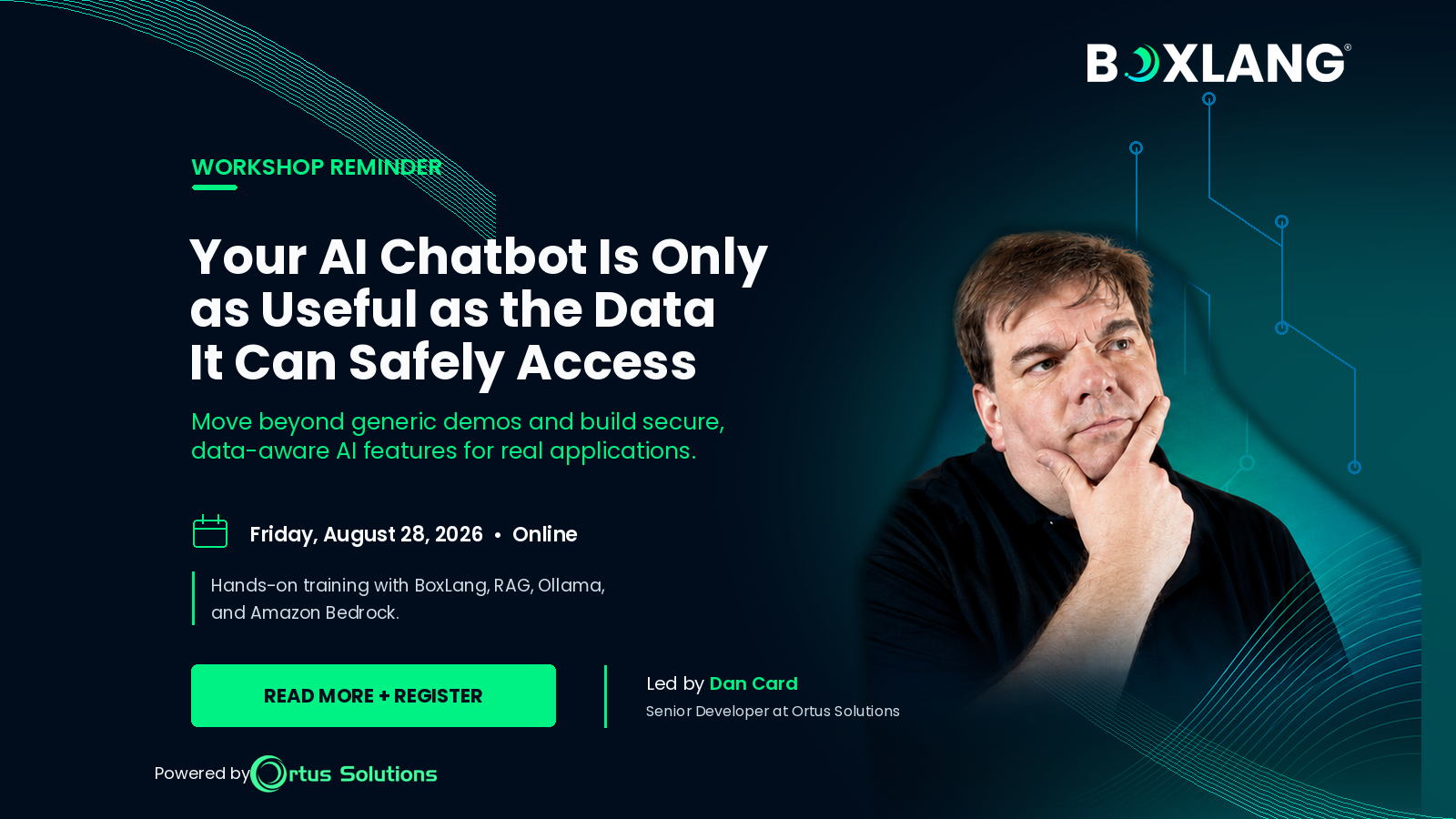
Your AI Chatbot Is Only as Useful as the Data It Can Safely Access
Connecting an application to an AI model is easy enough to demonstrate. The harder question is what happens next:
How does the model access the information your users actually need without exposing sensitive data, losing control over retrieval, or locking your application into one deployment strategy?
That gap between a basic chatbot and a useful application is exactly where many development teams get stuck. A model may generate fluent answers, but without trusted context from your documents, databases, and existing systems, those answers can remain generic—or confidently wrong.
The workshop is this Friday, August 28. Get your ticket and review the full workshop details on Eventbrite.
A Personal Invitation from Dan Card
Hear directly from Dan about his practical, no-hype approach to AI and what you can expect from the workshop.
The Real Challenge Is Not the Chat Interface
The chat window is only the visible layer.
Behind it, developers still need to make decisions about data access, security, infrastructure, cost, and the code that determines which information reaches the model.
For an AI feature to become useful inside a real web application, it needs a controlled way to answer questions using information that the model was not originally trained on. That may include internal documentation, policies, product information, support resources, customer records, or data already stored in an application database.
Simply sending all that information to a model is not a responsible or scalable solution. Developers need a retrieval process they understand and control.
Why RAG Matters for Real Applications
Retrieval-Augmented Generation, or RAG, allows an application to retrieve relevant information first and provide that context to the AI model when it generates a response.
Instead of expecting the model to know everything, the application supplies the information needed for a specific question.
This approach can help teams create AI experiences that are more relevant, easier to update, and better connected to the data their applications already use. It also gives developers an important layer of control over what is retrieved and how it is presented to the model.
But implementing RAG introduces practical questions that a simple prompt tutorial rarely answers:
- How should documents be prepared and made available for retrieval?
- How can database data be included without giving the model unrestricted access?
- What information should the application retrieve for each question?
- How do you maintain security and authorization rules throughout the process?
- Should the system run locally, in the cloud, or use a combination of both?
Local AI or Serverless AI? The Answer Depends on the Application
Running a language model locally with Ollama can provide greater control over the environment and where data is processed.
A serverless platform such as Amazon Bedrock offers a different balance of scalability, managed infrastructure, provider access, and operational cost.
Neither approach is automatically right for every project.
The important skill is understanding the tradeoffs well enough to choose an architecture based on the application’s security requirements, data, scale, infrastructure, and budget—not simply because one option is currently receiving more attention.
Start Small, Then Build Toward Something Useful
Dan Card describes himself as an AI skeptic, and that perspective shapes this workshop.
The goal is not to replace an entire development workflow or rebuild every application around AI. It is to begin with a focused use case, understand each layer, and add functionality in controlled steps.
During this full-day online workshop, participants will start with a simple, ongoing chat application and progressively add the capabilities needed for more practical use cases.
You will learn how to:
- Build a conversational AI chat application using BoxLang and the
bx-aimodule - Add documents and database-driven information through RAG
- Work with a locally hosted model using Ollama
- Integrate Amazon Bedrock securely using IAM
- Compare the practical benefits and economics of self-hosted and serverless AI
- Develop tools that help the AI engine determine how to retrieve the information it needs
Rather than stopping at theory or prompt writing, you will work with the code responsible for retrieving data, supplying context, and connecting the AI layer to an actual application.
Why This Matters for Developers Now
Clients and organizations are increasingly asking development teams where AI could improve products, internal tools, support systems, and everyday workflows.
Developers do not need to accept every AI claim to prepare for those conversations. They do need enough practical experience to evaluate a request, identify the risks, and recommend an approach that can work in production.
Understanding how to build a small, controlled AI feature is a better starting point than adopting a platform without understanding how it handles data.
It gives developers the ability to separate useful opportunities from hype—and to build with intention when the use case makes sense.
Join Dan Card This Friday
Creating Simple and Complex Chat Applications with a Locally Based AI System takes place online on Friday, August 28, 2026.
The workshop is designed for BoxLang and ColdFusion developers, software engineers, technical leads, and teams interested in adding practical AI capabilities to real web applications.
Basic BoxLang or ColdFusion knowledge is encouraged. Participants will need:
- A working BoxLang installation
- An AWS account or a Docker-enabled environment, such as Docker Desktop
Attendees will also receive access to a private Slack channel for assistance with prerequisites and follow-up questions after the workshop.
Only a few days remain. Get your ticket on Eventbrite and join Dan Card for a practical day of building secure, data-aware AI applications.
Duo and Team Packs are available for colleagues and development teams who want to learn and build together.
Join the Ortus Community
Be part of the movement shaping the future of web development. Stay connected and receive the latest updates on product launches, tool updates, promo services, and much more. Subscribe to our newsletter for exclusive content.
Follow Us on Social media and don’t miss any news and updates:


Add Your Comment