
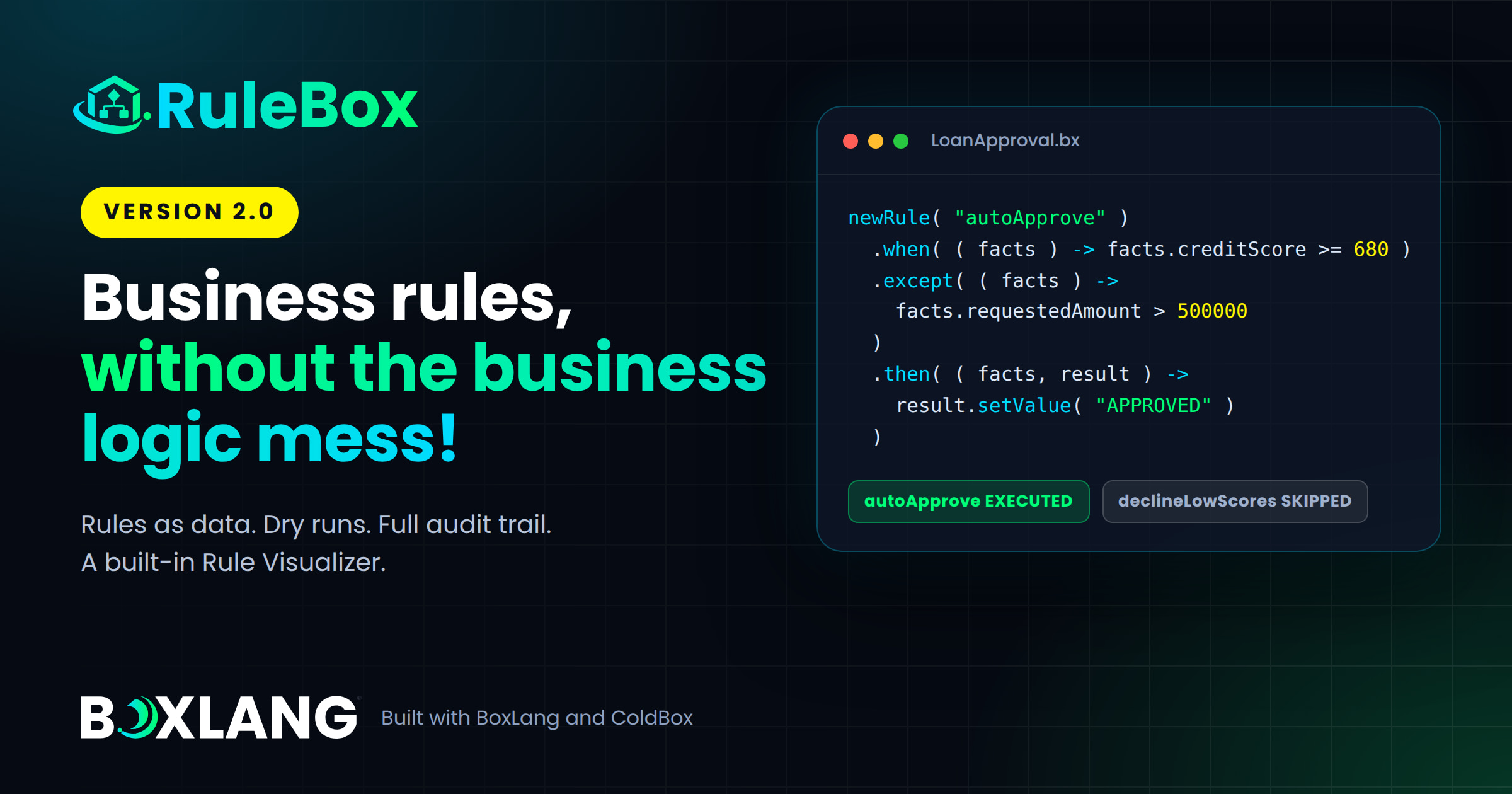
Ortus Solutions today announces the general availability of RuleBox 2.0.0, a modern, natural-language rules engine for BoxLang and ColdBox applications. It is a BoxLang-only rewrite, and it ships with rules as data, declared rulebooks, dry runs, an audit trail, and a built-in Rule Visualizer.
Every application grows a pile of business decisions: who gets approved, which discount applies, what ships for free, when a promotion ends. They usually start as one clean if and end as a 300-line method nobody wants to touch. If you have been there, keep reading!
RuleBox turns that pile into named rules you can read, test and audit. Given some facts, when a condition holds, then act. In BoxLang, or as JSON/YAML/DB your team can change without a deploy.
box install rulebox
BoxLang is why this is so small
A rules engine lives or dies on its developer experience. If writing a rule feels heavier than writing the if, nobody adopts it. That is exactly where BoxLang shines as a software productivity platform:
- Lambdas and closures are the DSL. A rule's
when()andthen()are plain BoxLang functions. There is no separate rule language to learn, no parser to debug, and your IDE already understands every line. - Fluent by default. Dynamic typing and method chaining let a rule read like the sentence your business analyst would write.
- 100% Java interop. A rule can call any Java library, so your decision logic is never boxed in.
- One language, top to bottom. The same BoxLang runs your rule, your ColdBox handler, your service and your tests.
- The Box ecosystem does the plumbing. WireBox injects rulebooks, ColdBox registers the module and its helpers, CommandBox installs it, and TestBox tests it.
RuleBox 2.0 also ships an AGENTS.md and tons of skills (https://skills.boxlang.io) so AI coding agents know how the module works before they write a line against it. Fewer wrong guesses, faster results.
A rule in sixty seconds
A rulebook is a class that extends rulebox.models.RuleBook. Each rule is named, has a condition, and does something when it fires:
class extends="rulebox.models.RuleBook" {

	function defineRules(){
		addRule(
			newRule( "declineLowScores" )
				.withPriority( 20 )
				.when( ( facts ) -> facts.creditScore < 580 )
				.then( ( facts, result ) -> result.setValue( "DECLINED" ) )
				.stop()
		)
		addRule(
			newRule( "autoApprove" )
				.when( ( facts ) -> facts.creditScore >= 680 )
				.except( ( facts ) -> facts.requestedAmount > 500000 )
				.then( ( facts, result ) -> result.setValue( "APPROVED" ) )
		)
	}

}
Run it from a handler, a service, or anywhere you can call getInstance():
getInstance( "LoanApproval" )
	.run( { creditScore : 720, requestedAmount : 250000 } )
	.getResult()
	.getValue() // "APPROVED"
Notice the -> arrows. These rules need nothing outside their facts, so they are lambdas. If a rule needs to capture outside state, use a closure with => instead.
What's new in 2.0
Rules as data
Keep logic that rarely changes in BoxLang. Move the thresholds that change often into JSON, YAML or a database table and load them with loadRules():
ruleBook.registerAction( "decide", ( facts, result, params ) -> result.setValue( params.decision ) )

ruleBook.loadRules( new rulebox.models.JSONRuleSource( "/path/to/loan.json" ) )
[
	{
		"name": "autoApprove",
		"when": { "gte": [ "creditScore", 680 ] },
		"except": { "gt": [ "requestedAmount", 500000 ] },
		"then": [ { "action": "decide", "params": { "decision": "APPROVED" } } ]
	}
]
Conditions use a small declarative grammar (eq, lt, gte, in, and, or, not and friends) with no eval. A rule definition can only reference actions and predicates you registered, so a rules file or a database row can never run code you did not write. Definitions are validated at load time, so a malformed rule fails on startup instead of on the day a short-circuited branch is finally reached. Need to pick up an edit? Call reloadRules() when you decide it is time. Read more in the External Rules guide.
Declared rulebooks
Name your rulebooks in config, or drop JSON and YAML files in a convention folder, then get them anywhere by name:
moduleSettings = {
	rulebox = {
		rulebooks = {
			"credit" : "config/rules/creditscore.yaml"
		}
	}
}
// in any handler, view or layout
ruleBook( "credit" ).run( { creditScore : 650 } ).getResult().getValue()
Or inject a provider into any class, including singletons. Each get() returns a fresh rulebook, so concurrent requests never share state:
class singleton {

	property name="creditRules" inject="rulebook:credit";

	function decide( score ){
		return creditRules.get().run( { creditScore : score } ).getResult().getValue()
	}

}
Dry runs and a full audit trail
Ask what would happen for a set of facts without running a single action:
getInstance( "LoanApproval" ).dryRun( { creditScore : 540, requestedAmount : 1 } )
// [ { name : "declineLowScores", wouldExecute : true, wouldStop : true } ]
After a real run, getRuleStatusMap() tells you which rules were EXECUTED, SKIPPED, STOPPED or FAILED. 2.0 also tracks per-rule metrics across runs: evaluation counts, durations, error rates and the last error with its stack trace.
Priorities, stops and time windows
withPriority() orders rules regardless of insertion order, stop() ends the chain, and the new active() turns a rule on for a season or a campaign and lets it expire on its own:
newRule( "blackFridayPromo" )
	.active( from : "2026-11-27", until : "2026-11-30" )
	.then( ( facts, result ) -> result.setValue( "BLACK_FRIDAY" ) )
Declared facts
A rulebook can now declare the facts it takes, with a type, a default, a description and an example. Call enforceFacts() and a bad run fails before any rule executes, with a message that lists every problem:
function defineFacts(){
	enforceFacts()
	fact( "creditScore" ).type( "numeric" ).required().example( 680 )
}
RuleBox.InvalidFactsException: RuleBook [] was given invalid facts: Missing required fact [creditScore].
Safer by design
Singleton objects are now thread safe. A then() consumer that throws is recorded as FAILED in the audit trail before the exception reaches your code. The audit trail resets on every run(), so a rule your chain did not reach never reports a stale status. And overwrite on given() is finally honored.
The Rule Visualizer
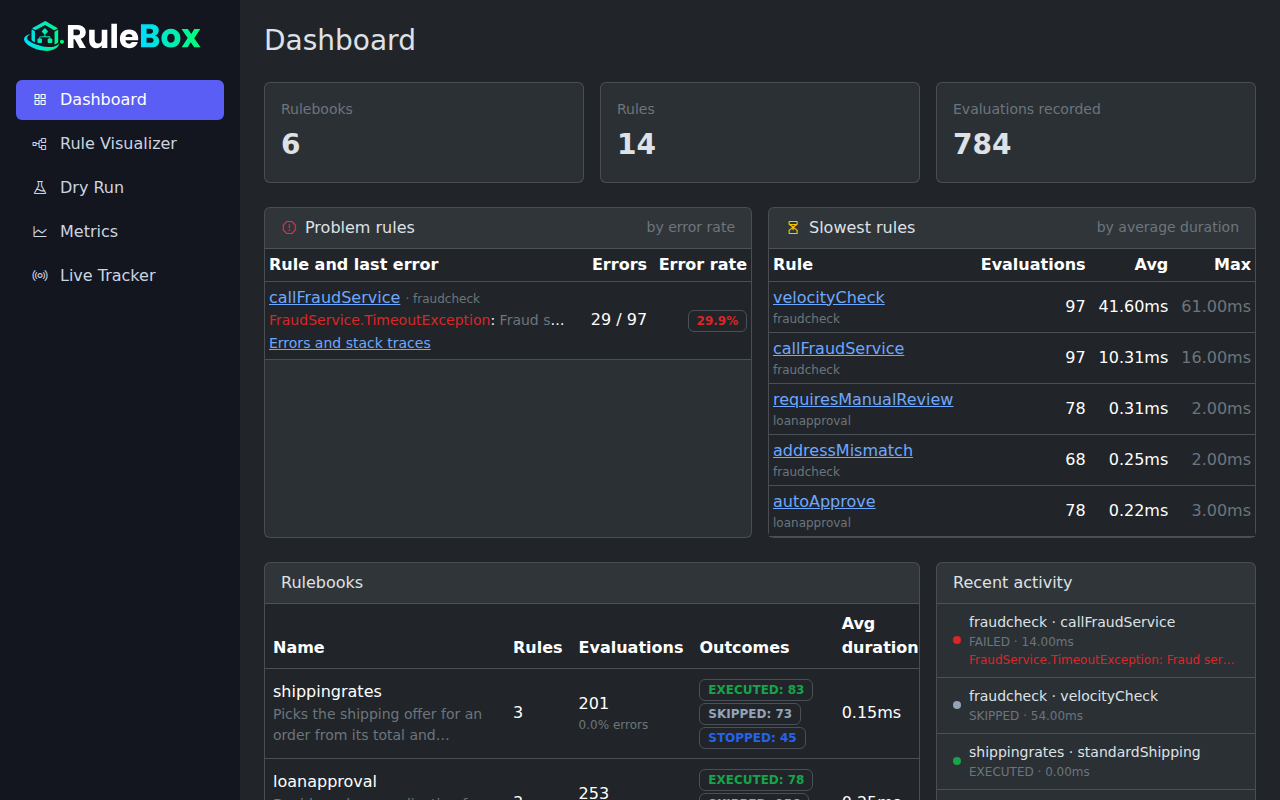
2.0 ships with a built-in admin UI. Turn it on with one setting:
moduleSettings = {
	rulebox = {
		visualizer = { enabled = true }
	}
}
Then browse to /rulebox-visualizer. It is off by default, does zero extra work while disabled, and is not secured by RuleBox itself, so wrap it with cbSecurity or your own auth like any other admin screen.
One-minute tour

Click the image to watch the video.
The Visualizer, screen by screen
| 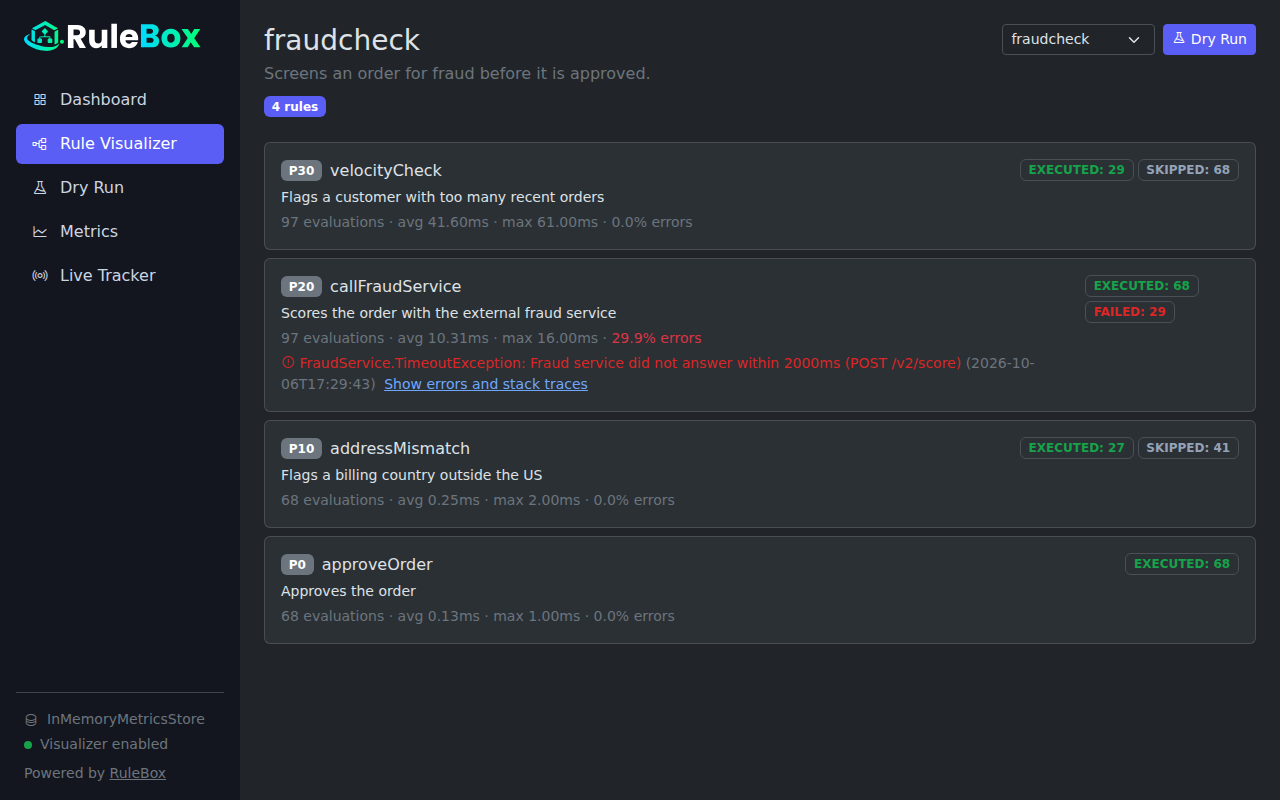 |
| Dashboard: every rulebook, plus the rules that fail most and the slowest ones | Chain view: rules in run order with durations, error rates and the last error |
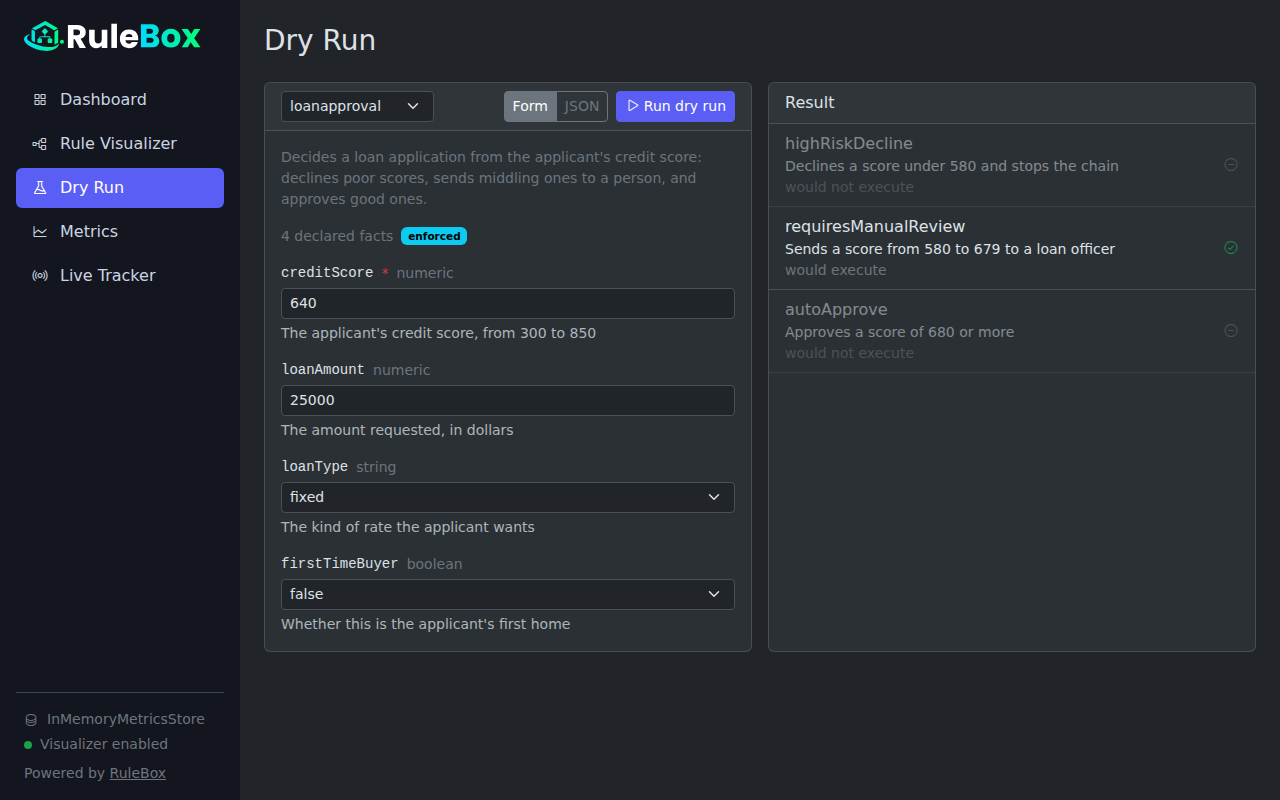 | 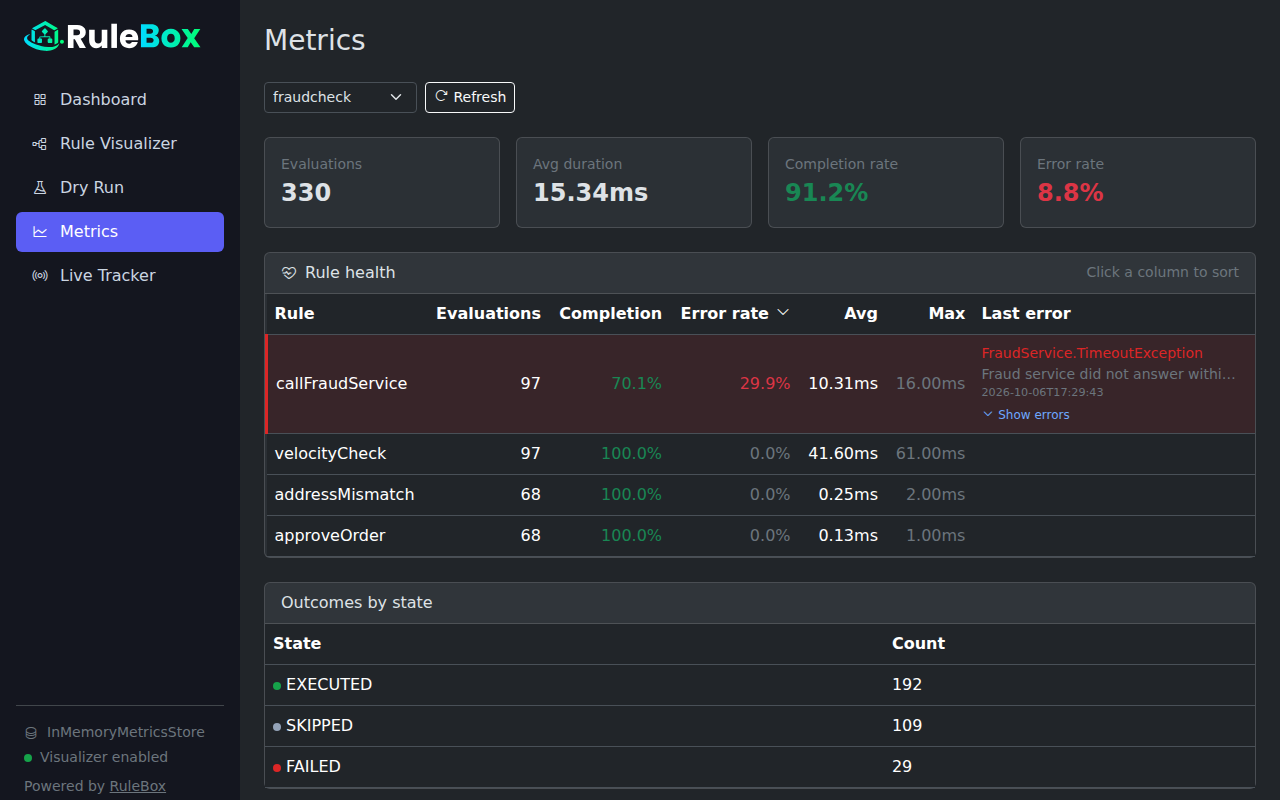 |
| Dry run: type facts and see which rules would fire | Metrics: completion and error rates, and every rule's health |
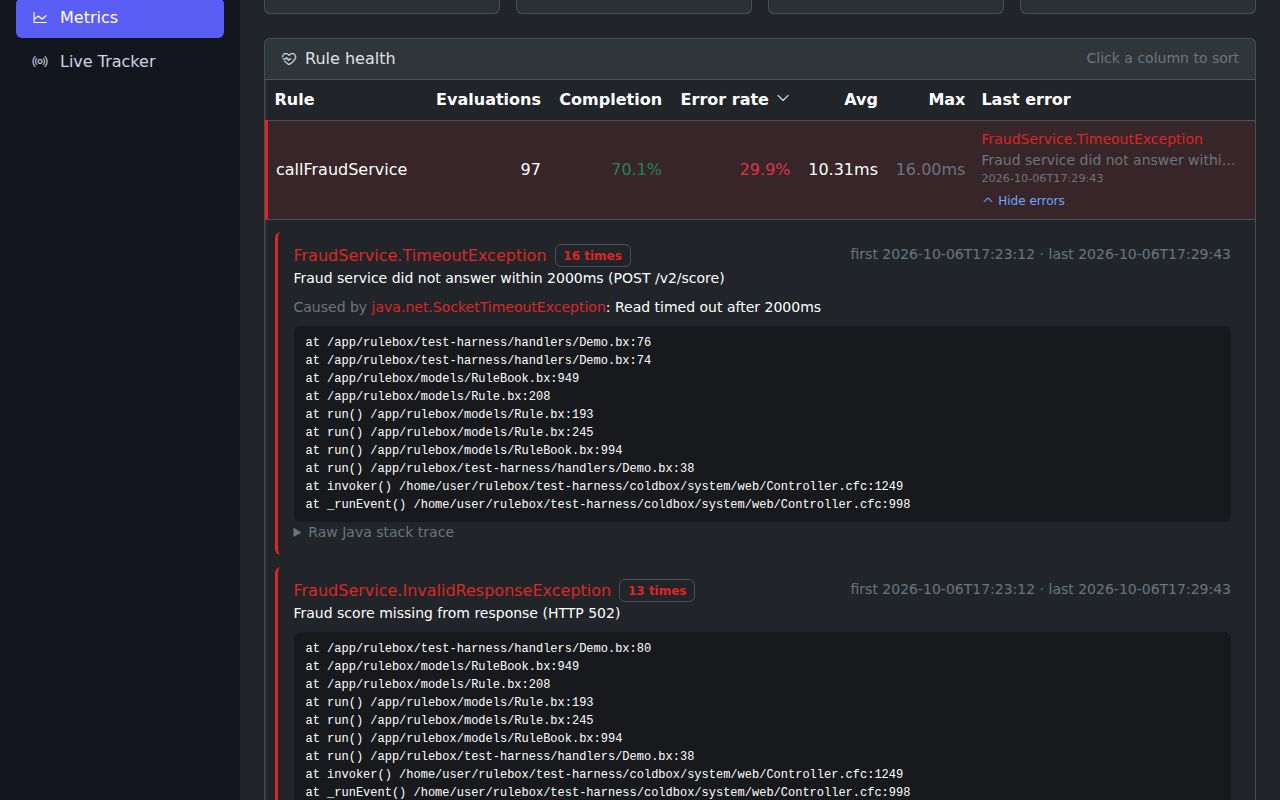 | 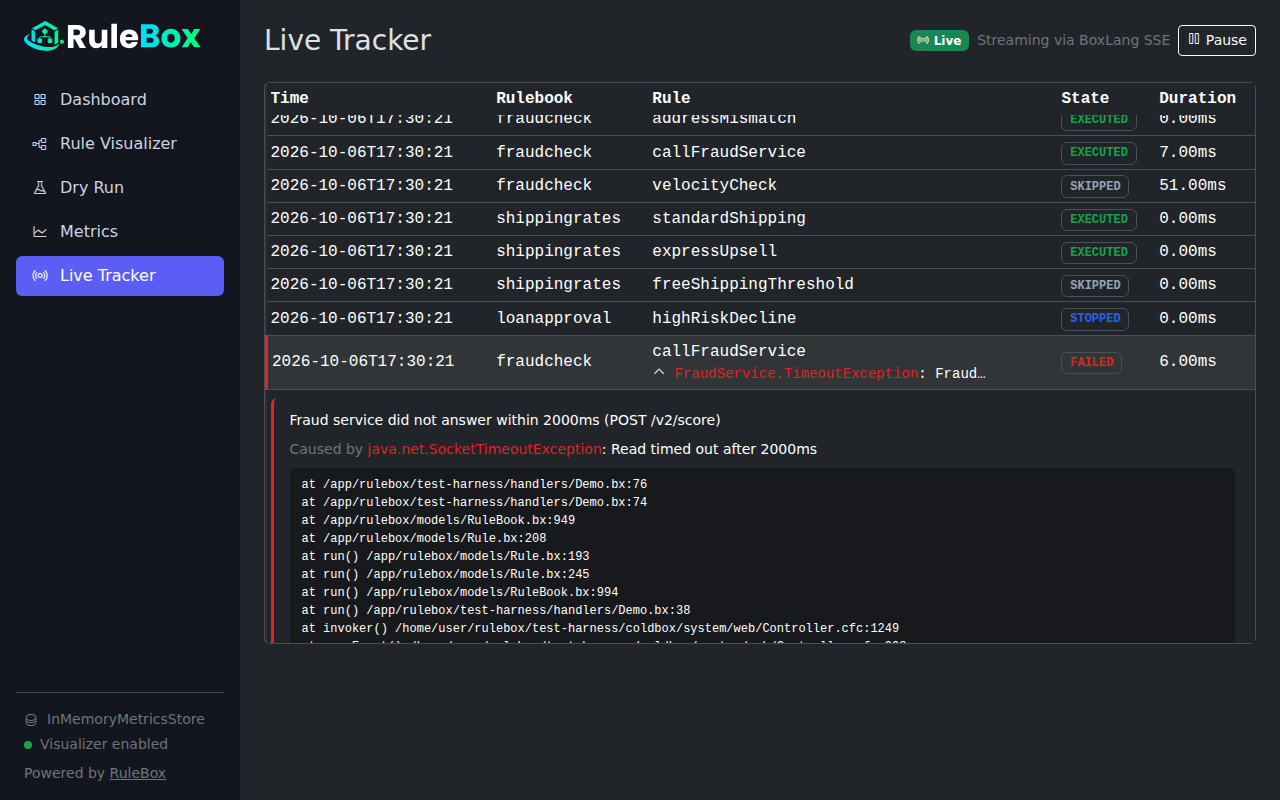 |
| Errors: each distinct error once, with a count, its cause and where it was thrown | Live tracker: every evaluation as it happens, with failures expanded |
Learn it in ten short lessons
New to rules engines? The Tutorial Course takes you from a single if statement to a loan decision with rules in a file, running inside ColdBox and showing up in the Visualizer. Ten short lessons, one running example.
Migrating from 1.0.0
2.0.0 is a rewrite, so check these before you upgrade:
- Run on BoxLang 1.18+. Other engines are no longer supported.
- Replace
NONEwithREGISTERED. A rule that was added but not reached now has the stateREGISTERED. Update any code that compares a status to"NONE". - Do not rely on stale statuses.
getRuleStatusMap()is reset at the start of everyrun(). - Check
overwriteongiven()andgivenAll(). It used to be ignored. Nowoverwrite = falsekeeps existing facts. - Attach rules before calling
run(). Running aRulethat was never added to aRuleBookthrowsRuleBox.RuleNotAttachedException.
The 1.0.0 docs are kept in the archive, and the full line-by-line history is in the changelog.
Get started
Requirements: BoxLang 1.18+ and ColdBox 8+.
box install rulebox
Two features need optional BoxLang modules that RuleBox does not install for you: box install bx-yaml for YAML rule files, and box install bx-sqlite if you want Visualizer metrics to survive a restart.
Save a rulebook as models/HelloWorld.bx, call getInstance( "HelloWorld" ).run( { name : "World" } ), and you are running rules. The full walkthrough is in the Getting Started guide.
Join in
RuleBox is open source under Apache 2.0. Star the repo on GitHub, open issues and pull requests, and tell us what you want to see next in the Ortus Community Slack or the Community Forum.
Resources
- Website and docs: rulebox.coldbox.org
- Tutorial Course: rulebox.coldbox.org/course
- Source: github.com/coldbox-modules/rulebox (Apache 2.0)
- BoxLang: boxlang.io | BoxLang docs
- ColdBox: coldbox.org
- Professional support and consulting: ortussolutions.com/services
Stop burying business decisions in if blocks. Start writing rules.




Add Your Comment