
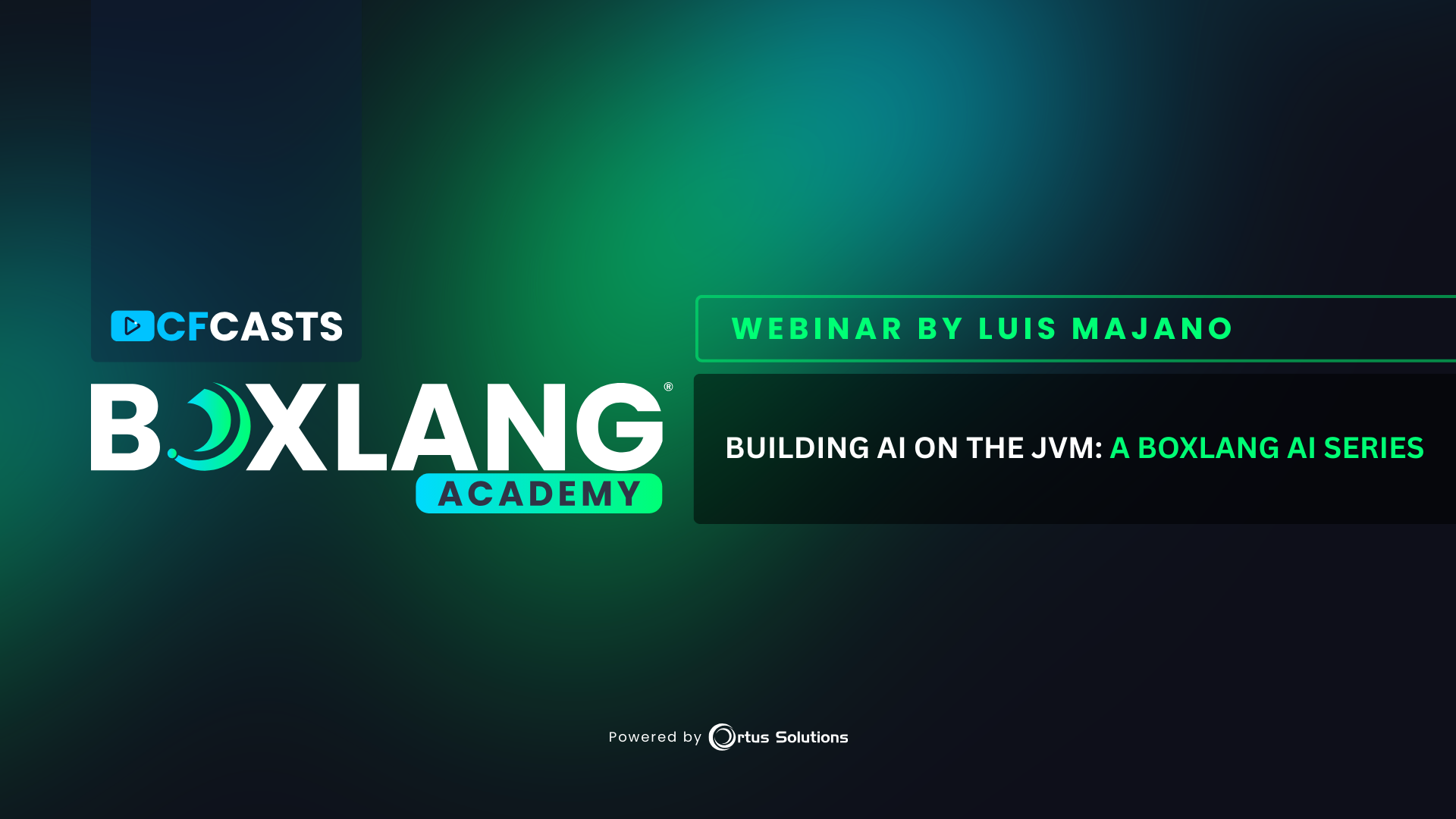
We are excited to announce a major new addition to BoxLang Academy: the 7-part video series, Building AI on the JVM: A BoxLang AI Series
Artificial Intelligence is no longer a distant frontier, it’s a core requirement for modern enterprise software. But for JVM developers, the path to integration has often been fragmented. That ends today. With the launch of this series, we are showing you exactly how to leverage the BoxLang AI (BXAI) platform to build intelligent, scalable applications with ease.
🧠 Master Enterprise AI Orchestration
Hosted by Luis Majano, this series is a practical deep dive into the BXAI framework. You won't just learn about LLMs; you’ll learn how to orchestrate them into professional workflows.
What's inside the series?
- Unified Development: See how BoxLang centralizes over 14+ AI providers (OpenAI, Anthropic, Gemini, Ollama, etc.) under a single API.
- Advanced Architectures: Master RAG (Retrieval Augmented Generation) and tool calling to make your AI data-aware.
- Type Safety: Learn to use Structured Outputs to ensure your AI responses actually work with your code.
- Multimodality: Explore how to process images and PDFs directly within your AI pipelines.
🛠️ The Platform: Why BoxLang AI?
While the Academy teaches you the how, the BoxLang platform provides the tools. By adding BXAI to your stack, you gain:
- Zero Vendor Lock-in: Switch between LLM providers with a simple configuration change.
- Seamless JVM Integration: Works natively with your existing Java and ColdFusion/CFML investments.
- Agent Orchestration: Build autonomous agents that can think, remember, and act within your business logic.
📺 Start Watching Now
The entire series is free and available now on the Academy. Whether you have an hour to binge the whole thing or want to take it one episode at a time, your journey to becoming an AI-enabled JVM developer starts here.👉 Join the Series at BoxLang Academy💡 Ready to Build?
Once you've watched the series, put your knowledge into action:
- Explore the Docs: Dive deeper into the technical specs at ai.ortusbooks.com.
- Install the Module: Get started immediately by installing the
bx-aimodule in your BoxLang environment.
Join the Ortus Community
Be part of the movement shaping the future of web development. Stay connected and receive the latest updates on product launches, tool updates, promo services, and much more. Subscribe to our newsletter for exclusive content.
Follow Us on Social media and don’t miss any news and updates:





Add Your Comment