
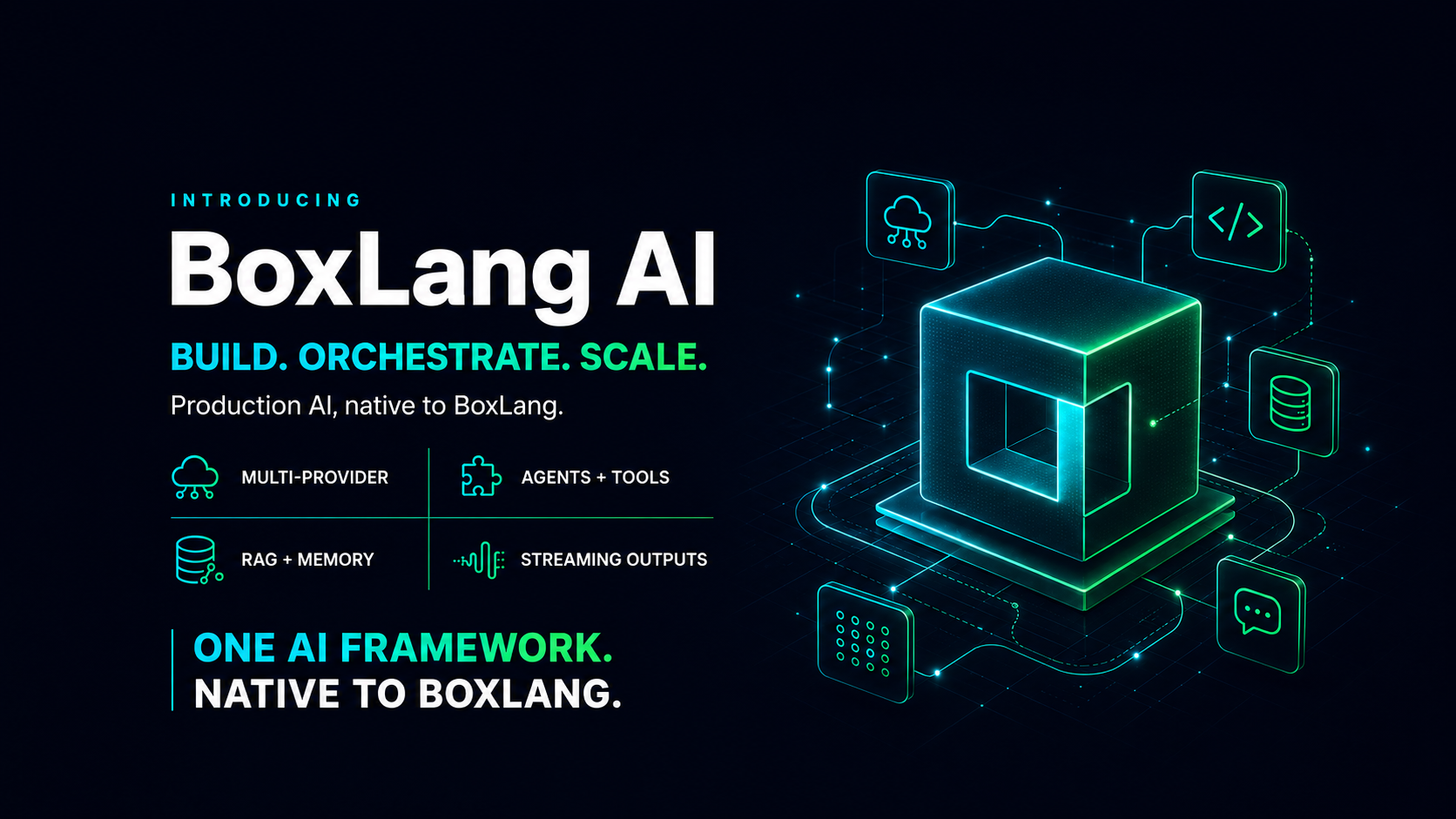
Introducing BoxLang AI: Build Intelligent Applications with One Unified AI Platform
Artificial intelligence is opening new possibilities for web applications, but building those experiences can become complicated quickly.
Each AI provider brings its own SDK, authentication process, APIs, and model-specific requirements. Add agents, memory, tools, structured responses, or document retrieval, and development teams can find themselves managing integrations instead of improving their applications.
Introduced at Into the Box 2026, BoxLang AI gives developers a more unified way to build AI-powered applications within the BoxLang ecosystem.
Rather than tying an application to one provider or one type of AI workflow, BoxLang AI provides a consistent foundation for working with multiple models and building features such as assistants, enterprise copilots, intelligent workflows, and Retrieval-Augmented Generation (RAG) systems.
One Consistent Approach to AI Development
Choosing an AI provider should not define the entire architecture of your application.
BoxLang AI offers a unified API that abstracts many provider-specific implementation details. This gives developers a consistent programming model while preserving the flexibility to select different providers and models for different use cases.
Teams can experiment with models, compare results, manage costs, or change providers without rebuilding every AI feature from the beginning.
For developers, that means less time learning and maintaining separate SDKs. For organizations, it creates a more adaptable foundation as models, providers, and AI requirements continue to evolve.
Go Beyond the Chatbot
A conversational interface may be the most visible example of AI, but it is only one of the experiences modern applications can deliver.
BoxLang AI brings together capabilities for building more complete intelligent workflows, including:
- AI agents
- Tool calling
- Structured outputs
- Streaming responses
- Memory management
- Retrieval-Augmented Generation
- Multi-agent orchestration
- Middleware
- Model Context Protocol integration
These capabilities allow an application to do more than generate text. An AI-powered workflow could retrieve internal information, interact with an external service, process a document, preserve conversational context, and return a structured response that the rest of the application can use.
Because these features are available through one framework, developers can focus on how intelligence improves the application instead of assembling a different library for every requirement.
Bring AI Into Your Existing Web Applications
BoxLang AI is built natively for the BoxLang ecosystem, making it a practical option for teams that want to add intelligent capabilities to their web applications.
You might use it to create:
- A support assistant grounded in product documentation
- An internal copilot that works with company knowledge
- A document intake and processing workflow
- A tool-using agent that connects with business services
- A contextual assistant embedded in an existing application
- A coordinated group of specialized agents for more complex tasks
The goal is not to add AI simply because it is new. It is to help developers create useful experiences that reduce manual work, make information easier to access, and give users better ways to interact with an application.
You can begin with one focused feature and expand as the use case becomes clearer.
Designed to Grow with Your Application
AI development is moving quickly. Models change, providers introduce new capabilities, and application requirements become more sophisticated.
A unified, provider-agnostic framework helps teams respond to those changes without making the underlying application dependent on a single service. It also creates a clearer path from early experimentation to maintainable AI features that can become part of a broader application architecture.
With BoxLang AI, agents, tools, memory, retrieval, models, and application logic can work together within the same ecosystem. This allows teams to build on familiar BoxLang foundations while exploring new ways to improve their applications.
Start Building with BoxLang AI
The best way to understand what BoxLang AI can bring to your application is to try it with a real use case.
Start with a feature your users or team already need: search internal knowledge, summarize documents, automate a repetitive workflow, connect an assistant to an existing service, or introduce a more intelligent interface to your web application.
Then explore the BoxLang AI resources:
- 🤖 BoxLang AI: https://ai.boxlang.io/
Learn about the platform, supported providers, features, examples, and the latest AI capabilities available for BoxLang developers.
- 📖 BoxLang AI Documentation: https://ai.ortusbooks.com/
Explore installation guides, tutorials, API references, provider configuration, agents, RAG workflows, memory systems, and production best practices.
- 🧠 BoxLang Skills Registry: https://skills.boxlang.io/
Browse a growing collection of reusable AI Skills created by the BoxLang community to accelerate development and extend intelligent applications.
- 💻 BoxLang: https://boxlang.io/
Discover the modern JVM language powering BoxLang AI, along with its runtimes, ecosystem, documentation, and developer resources.
- 📦 BoxLang AI on GitHub: https://github.com/ortus-boxlang/bx-ai
Explore the source code, contribute to the project, report issues, and stay up to date with the latest development.
Try BoxLang AI and start building intelligent features that elevate what your web applications can do.
Join the BoxLang Community
Be part of the growing BoxLang community. Connect with other developers, ask questions, contribute to the ecosystem, and receive the latest BoxLang news, releases, events, and technical resources.
Stay connected:
- Newsletter: https://newsletter.boxlang.io
- Community: https://community.ortussolutions.com/c/boxlang/42
- Slack: https://www.ortussolutions.com/community/slack
- X: https://x.com/TryBoxLang
- Facebook: https://www.facebook.com/tryboxlang
- LinkedIn: https://www.linkedin.com/company/tryboxlang
- YouTube: https://www.youtube.com/OrtusSolutions
- GitHub: https://github.com/ortus-boxlang



Add Your Comment