
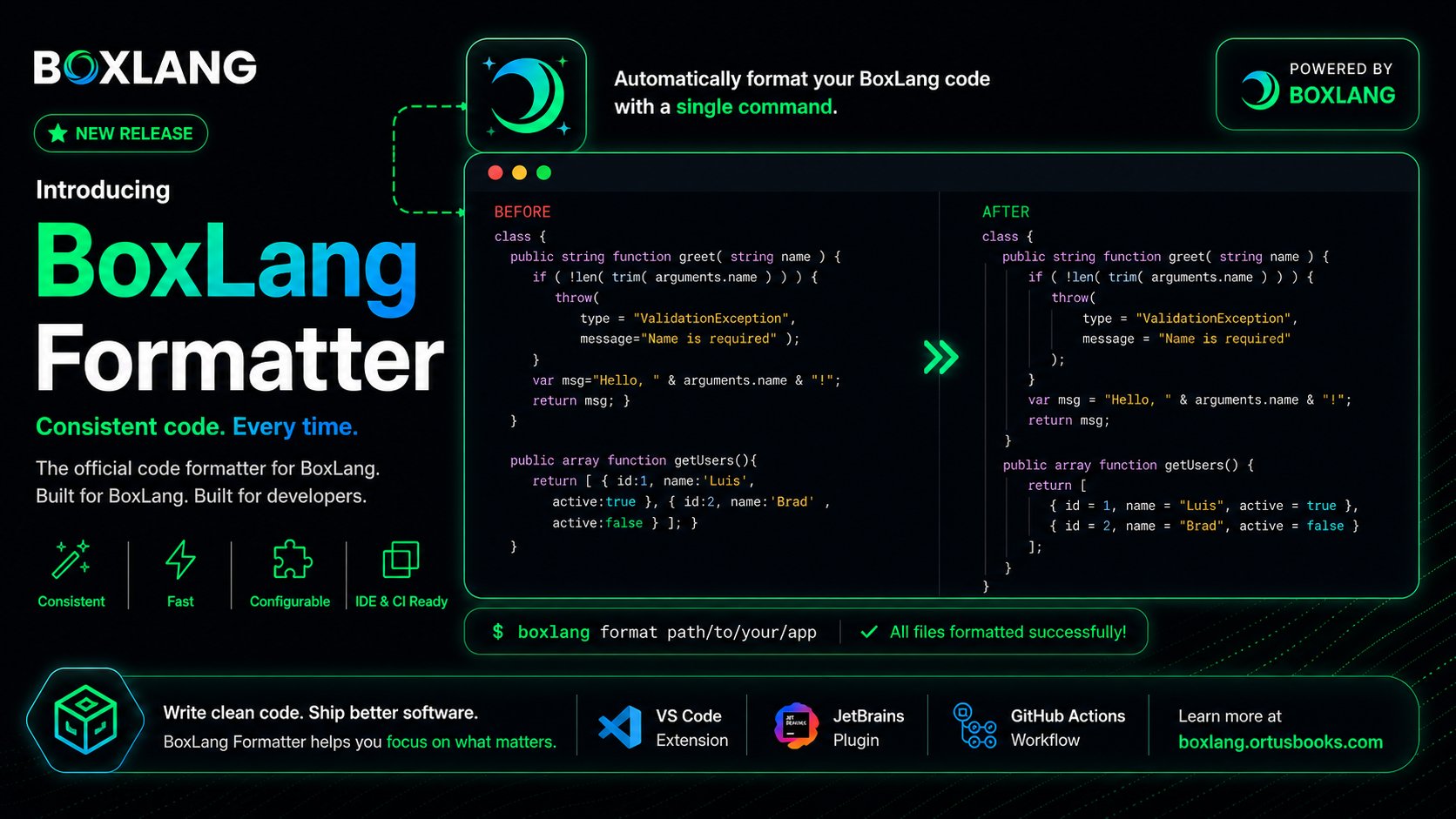
You know the drill. Someone opens a PR and half the review comments are about tabs vs spaces, where braces go, or why that one function has its arguments formatted differently from everything else. It's noise. And it's over.
The BoxLang Formatter is here, and it handles all of that for you.
You can find the docs here: https://boxlang.ortusbooks.com/getting-started/ide-tooling/boxlang-formatter
What Is It?
The BoxLang Formatter is a built-in code formatting tool that ships with BoxLang. It enforces consistent style across .bx, .bxs, .bxm, .cfm, .cfc, and .cfs files — automatically.
It's not a linter. It doesn't just complain. It fixes your code, or tells CI to fail when style drift sneaks in.
Getting Started in 60 Seconds
If you have BoxLang installed, you already have the formatter. No extra install needed.
Format everything in your current directory:
boxlang format
That's it. It recurses through your project and rewrites supported files in place.
Want to target a specific path or file?
# A directory
boxlang format --source ./src

# A single file
boxlang format --source ./models/User.bx
Multiple paths at once (v1.14+):
boxlang format --source commands,models,services
Configure Your Style
The formatter works great out of the box with sensible defaults, but you can customize it with a .bxformat.json file in your project root.
Bootstrap one instantly:
boxlang format --initConfig
This drops a starter config in your current directory. From there, tweak what you care about. Here's a minimal example:
{
  "maxLineLength": 120,
  "tabIndent": true,
  "singleQuote": false,
  "braces": {
    "style": "same-line",
    "require_for_single_statement": true
  },
  "operators": {
    "comparison_style": "symbols"
  }
}
You've got control over indentation, line length, brace style, struct/array formatting, operator style, SQL keyword casing, import sorting, and a lot more. Only override what you need — everything else uses sensible defaults.
Lock It Down in CI
This is where it gets really useful. Run the formatter in check mode as a quality gate:
boxlang format --check --source ./
- Exits
0if everything is already formatted correctly - Exits non-zero if any file has drift
Drop that into your CI pipeline and pull requests with messy formatting simply won't merge. One command, no separate linter needed.
Recommended Team Workflow
- Developers run
boxlang formatbefore pushing - CI runs
boxlang format --checkon every PR - PRs that fail must reformat before merge
No more style debates in code review. The formatter wins.
Format on Save in VS Code
If you want formatting to happen automatically as you work, the BoxLang LSP supports experimental format-on-save.
Step 1 - Enable it in .bxlint.json:
{
  "formatting": {
    "experimental": {
      "enabled": true
    }
  }
}
Step 2 - Add this to your VS Code settings.json:
{
  "[boxlang]": {
    "editor.formatOnSave": true
  },
  "[boxlang-template]": {
    "editor.formatOnSave": true
  }
}
Step 3 - Open the Command Palette and run:
BoxLang: Select BoxLang Version(pick latest)BoxLang: Select LSP Version(pick latest)Developer: Reload Window
Save a .bx file and it just formats. Local fast feedback, CI enforcement as the source of truth.
Coming from cfformat?
Already using cfformat in your project? Migration is a two-step process, and your existing style intent is preserved.
Step 1 - Convert your config:
boxlang format --convertConfig --source ./
This transforms your .cfformat.json into a .bxformat.json, keeping your rules intact.
Step 2 - Validate with check mode:
boxlang format --check --source ./
See what (if anything) drifted. Run the formatter once in a cleanup commit, then turn on --check in CI and you're done.
A Few Other Handy Options
Preview without rewriting files — pipe output to stdout instead:
boxlang format --overwrite false --source ./handlers/MainHandler.cfc
Exclude directories (v1.14+):
boxlang format --source . --excludes generated,vendor
Use a custom config path:
boxlang format --config ./config/.bxformat.json --source ./
The Bottom Line
Stop spending review cycles on style. The formatter handles it — in your editor, in your pre-commit hook, in CI. One command, consistent output, zero arguments about semicolons ever again.
Go format something:
boxlang format
Questions? Hit us up on CFML Slack or open a discussion on the BoxLang repo. We'd love to hear how you're using it.



Add Your Comment