
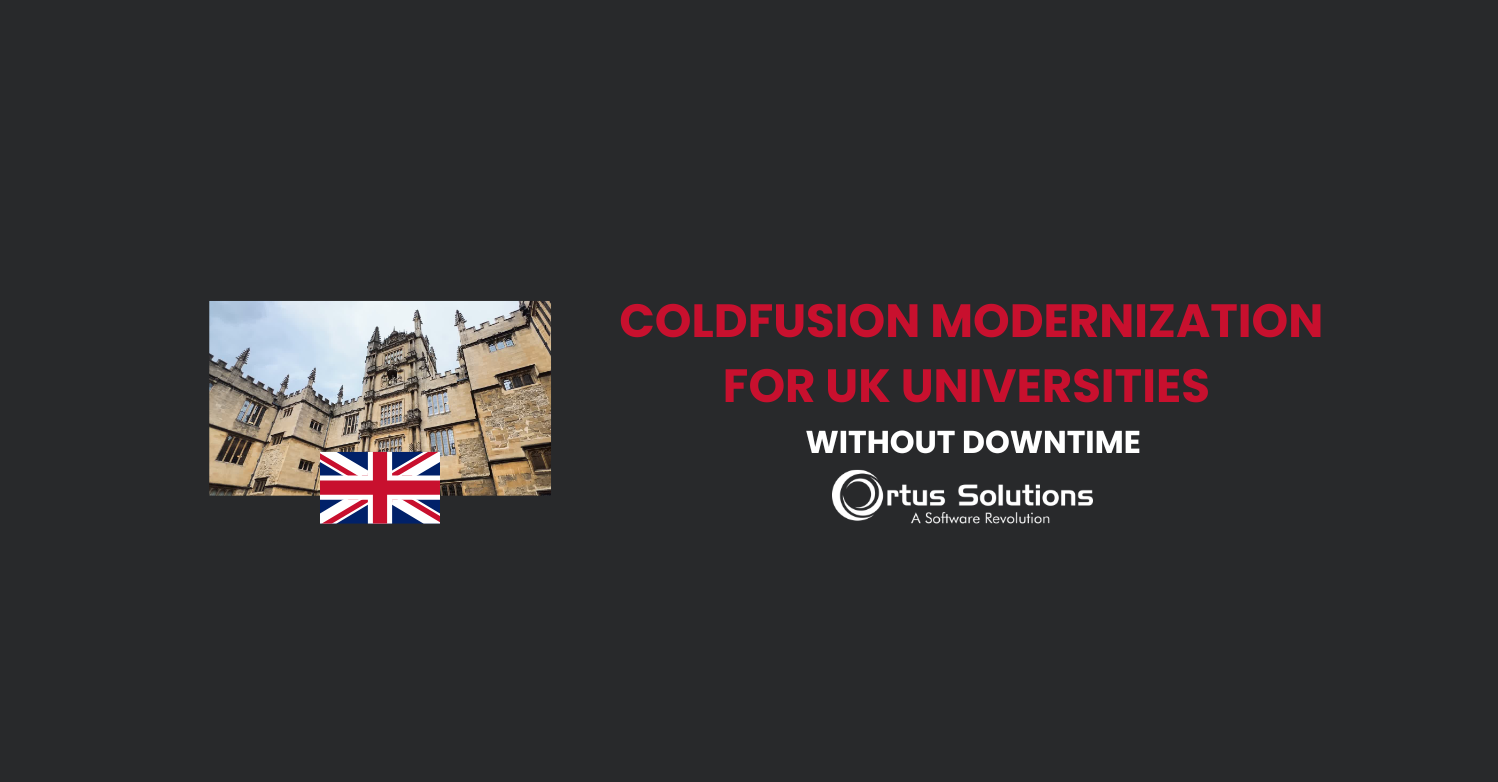
Across the United Kingdom, many universities still rely on legacy ColdFusion and CFML systems to power student portals, enrollment platforms, research databases, payment gateways, and internal academic workflows.
These systems are often:
- 15 to 25 years old
- Mission-critical
- Deeply integrated with student information systems
- Running on older Adobe ColdFusion or Lucee versions
- Tightly coupled monolithic architectures
For UK universities, modernization is no longer optional. However, the challenge is clear:
How do you modernize a legacy ColdFusion university portal without disrupting students, faculty, and administrative operations?
Why ColdFusion Still Powers UK University Portals
ColdFusion became popular in UK universities during the early 2000s because it allowed rapid development of:
- Student application portals
- Course management systems
- Alumni platforms
- Financial aid and bursary systems
- Internal administrative dashboards
Over time, these systems evolved into large CFML legacy platforms, often with limited documentation, mixed coding styles, and minimal automated testing.
Today, many UK university IT departments face growing pressure to:
- Improve security compliance under GDPR
- Reduce operational risk
- Migrate to cloud infrastructure
- Improve scalability during enrollment peaks
- Reduce dependency on a shrinking CFML talent pool
The Real Risk: Downtime in Higher Education Systems
In the United Kingdom, university systems cannot fail during:
- Enrollment periods
- Exam results publication
- Tuition payment deadlines
- Student visa processing
- Clearing season
Any downtime during these periods can result in:
- Reputational damage
- Student dissatisfaction
- Financial losses
- Compliance concerns
This makes a full rewrite unrealistic.
Most UK universities cannot afford to shut down their ColdFusion portals for months while rebuilding them from scratch.
Common Problems in UK ColdFusion University Systems
Through our work with legacy CFML systems, we consistently see similar patterns:
1. Monolithic Architectures
Many university portals were built as single large applications without modular separation.
2. Outdated Adobe ColdFusion Versions
Older ACF versions increase security and compliance risk, particularly under GDPR.
3. Manual Deployments
Lack of CI/CD pipelines increases deployment risk.
4. Limited Observability
No distributed tracing, inconsistent logs, and insufficient monitoring.
5. Talent Scarcity
Fewer developers in the United Kingdom specialize in ColdFusion, increasing operational risk.
A Safer Path: Progressive ColdFusion Modernization in the UK
Modernizing ColdFusion systems in UK universities does not require a disruptive rewrite.
A structured approach includes:
Step 1: Technical and Security Audit
Assess the ColdFusion stack, JVM configuration, dependencies, and infrastructure.
Step 2: Stabilization and Hardening
Upgrade outdated components, apply security patches, improve configuration.
Step 3: Progressive Refactoring
Break monolithic CFML systems into modular ColdBox or HMVC structures.
Step 4: CI/CD Implementation
Introduce automated pipelines to reduce deployment risk.
Step 5: Cloud-Ready Architecture
Prepare the system for containerization, Kubernetes, or hybrid cloud environments.
This approach ensures:
- Zero downtime modernization
- Operational continuity
- Compliance alignment
- Long-term sustainability
Cloud Migration for UK Universities Running ColdFusion
Many universities in the United Kingdom are moving toward:
- AWS UK regions
- Azure UK South / UK West
- Hybrid cloud strategies
However, legacy CFML systems often struggle with:
- Containerization
- Kubernetes orchestration
- Modern DevOps workflows
With the right modernization framework, ColdFusion applications can be:
- Containerized safely
- Deployed via CI/CD pipelines
- Integrated with modern authentication systems
- Scaled for peak academic traffic
Reducing Risk Without Rewriting Everything
A full rebuild is expensive, risky, and politically complex in university environments.
A progressive modernization strategy allows UK universities to:
- Protect existing investment
- Reduce technical debt
- Improve security posture
- Introduce modern cloud-native capabilities
- Maintain continuous service for students and faculty
Why UK Universities Choose Specialized CFML Modernization Partners
Modernizing ColdFusion in the United Kingdom requires:
- Deep CFML expertise
- Understanding of GDPR and UK compliance standards
- Experience with zero-downtime migrations
- Knowledge of cloud-native transformation
- Ability to train internal IT teams
A specialized partner can help universities move forward without disrupting academic operations.
Final Thoughts
ColdFusion still plays a critical role in many UK university systems.
The question is no longer whether modernization will happen, but how it will be executed.
The safest path forward is structured, progressive modernization that preserves operational continuity while preparing systems for the next decade.
If your university in the United Kingdom relies on ColdFusion or CFML for critical platforms, now is the time to evaluate a safe and controlled modernization roadmap. Contact us.


Add Your Comment