
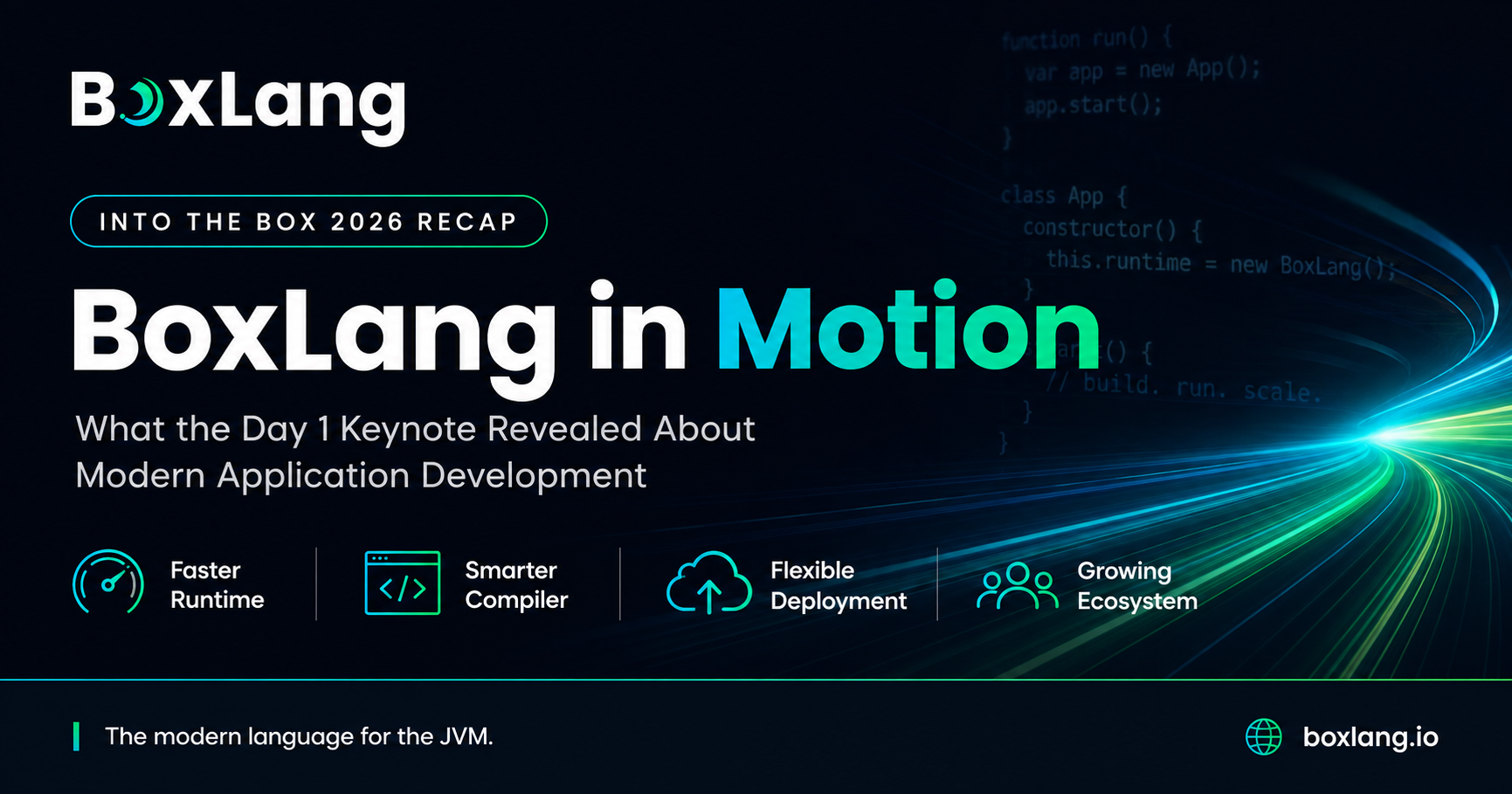
BoxLang in Motion: What the Day 1 Keynote Revealed About Modern Application Development
The Day 1 keynote at Into the Box 2026 was not simply a list of new BoxLang features.
It showed what happens when a language, compiler, runtime, deployment model, and developer ecosystem evolve together around one goal: helping teams build modern applications without unnecessary complexity.
Just 11 months after its first stable release, BoxLang had already delivered 13 minor releases, 82 new features, 258 improvements, and 501 bug fixes. Automated tests grew from 12,000 to more than 16,000, while the ecosystem expanded across modules, repositories, contributors, runtimes, cloud offerings, and developer tools.
Those numbers demonstrate momentum. But the more important story is what that work means for developers: a faster and smaller runtime, more expressive language features, stronger deployment options, and an ecosystem designed to support applications well beyond the language core.
Here is a closer look at that part of the Into the Box 2026 Day 1 keynote and why it matters for teams evaluating what they want to build next.
More Than a Language Release
BoxLang was designed as a modern, dynamic language for the JVM, but the language syntax is only one layer of the platform.
Underneath it is a collection of runtime services for capabilities such as caching, data sources, components, scheduling, logging, and configuration. These services can be extended through modules instead of forcing every new capability into the language core.
That distinction matters.
Applications rarely need only a language. They also need infrastructure, integrations, deployment options, observability, security, and tooling. BoxLang brings those pieces together in an ecosystem developers can extend as their applications grow.
The result is not a runtime that must contain everything. It is a foundation that can be adapted to different teams, applications, and environments.
Eleven Months of Measurable Progress
The keynote placed the growth of BoxLang into perspective.
According to the official Into the Box 2026 announcement recap, BoxLang’s first 11 months included:
- 13 minor releases
- 82 new features
- 258 improvements
- 501 bug fixes
- Growth from 12,000 to more than 16,000 automated tests
- Expansion from 30 to more than 55 official modules
- Growth from 10 to more than 30 contributors
- Expansion from five to more than 30 runtime targets and integrations
- Support for more than seven development environments and IDEs
Release counts alone do not make a platform mature. The important signal is where that work has been invested: compiler design, runtime performance, test coverage, language ergonomics, deployment flexibility, tooling, and production operations.
That is the work required to turn a new language into a platform teams can realistically build on.
A Compiler Built for Different Deployment Needs
Development and production do not always require the same runtime behavior.
During development, teams often want dynamic compilation and rapid feedback. In production, they may prefer applications that are compiled before deployment and cannot compile additional source code at runtime.
BoxLang supports both approaches.
The standard runtime includes the ASM compiler, which compiles BoxLang source directly into Java bytecode and supports runtime compilation. BoxLang also offers a NoOp runtime designed to execute precompiled applications without including runtime compilation capabilities.
For teams operating in security-sensitive or regulated environments, that separation creates a valuable deployment choice: preserve a dynamic workflow during development while shipping a smaller, precompiled runtime into production.
A separate Java bytecode compiler can also transform BoxLang source through Java and into bytecode for sourceless deployments, inspection, debugging, and additional optimization workflows.
Developers can explore the currently available options on the official BoxLang download and compiler page.
Smaller Output, Faster Workflows
Compiler improvements are also reducing how much output applications generate.
In the ColdBox scenario demonstrated during the keynote, compilation was reduced from nearly 3,000 generated class files to approximately 206. The resulting bytecode footprint decreased from around 20 MB to just over 6 MB.
That is not only a storage improvement.
Smaller output can mean less data to package and transfer through CI/CD pipelines, more compact container images, and fewer classes for the runtime to load. Faster compilation can also improve local development and reduce the delay before an application begins serving requests.
The keynote also presented improvements across query operations, component creation, parsing, compilation, startup time, disk usage, and memory consumption.
In the specific environments demonstrated:
- Query-of-query workloads averaged more than 17× faster than Adobe ColdFusion and approximately 5× faster than Lucee.
- Creating one million simple CFC instances was approximately 3× faster than Adobe ColdFusion and slightly faster than Lucee.
- The demonstrated ColdBox and TestBox application started in approximately 30 seconds on BoxLang, compared with around four minutes in the Adobe ColdFusion environment used for the comparison.
- The compared runtime footprint was approximately 8.5 MB for BoxLang and 169 MB for Adobe ColdFusion, with memory usage of approximately 128 MB and 768 MB respectively.
These results should be understood in the context of the keynote’s test scenarios rather than as guarantees for every application. Still, they reveal where the engineering effort is going: reducing overhead throughout the runtime instead of treating performance as one isolated feature.
Modern Syntax That Removes Everyday Friction
Some of the most practical improvements from the keynote were also among the smallest.
BoxLang continues to introduce language features that reduce repetitive code and make common operations more expressive, including:
- Spread operators
- Array and structure destructuring
- Structure shorthand
- Inclusive range expressions
- Cleaner array and structure loops
- Additional collection methods such as
chunk,flatMap,groupBy,reject,unique, andzip
A range expression can replace a manually constructed loop. Destructuring can extract several values in one operation. Improved loop syntax can expose an item and its index—or a key and its value—without additional assignments inside the loop.
None of these features needs to transform an entire architecture to be valuable. Their impact accumulates through hundreds of small interactions with the language.
Less boilerplate means developers can spend more time expressing application behavior and less time managing ceremony around it.
HTTP, Streaming, and Integration for Modern Applications
Modern applications depend heavily on external services and real-time communication. BoxLang’s HTTP capabilities are evolving to support those patterns more naturally.
A fluent HTTP API gives developers a readable, chainable way to construct and execute requests. Connection pooling helps applications reuse client connections, while streaming responses and Server-Sent Events allow data to move continuously between servers and clients.
BoxLang supports both SSE consumption and production, opening practical use cases such as:
- Live application logs
- Progress updates
- Notification streams
- AI response streaming
- Long-running process monitoring
- Real-time administration experiences
This work extends into SOAP builders, structured JSON logging, readable JSON output, and routing Java library logs through the BoxLang logging system.
The goal is not to add integrations simply to make a feature list longer. It is to make the language useful within the systems applications already need to communicate with.
Configuration Without Hard-Coding Infrastructure
Application configuration also needs to move across local development, containers, cloud services, and production environments without embedding credentials in source code.
BoxLang’s configuration namespace providers allow values to come from external sources, including environment variables and secrets-management services. This creates a consistent way for application code to request configuration while allowing the source of that value to change between environments.
Developers can work with local settings during development and retrieve protected credentials from infrastructure services in production without redesigning the application around each provider.
It is a small architectural boundary with an important outcome: application logic remains separate from credential storage and deployment-specific configuration.
Modules That Extend More Than the Runtime
BoxLang modules can be written in BoxLang or Java and can contribute services, integrations, functions, components, and tooling.
Updated conventions also create clearer boundaries between public module resources and private implementation details. Modules can expose intentional public assets while keeping internal files protected.
A bin convention allows modules to register executable commands, extending the module system beyond application runtime features and into developer workflows.
That means a module can do more than add functionality to an application. It can also deliver the command-line tools developers use to build, operate, or automate that application.
The growing module catalog can be explored through the BoxLang download center.
The Mini Server Is Becoming a Serious Runtime Option
The BoxLang Mini Server began as a lightweight way to run web applications. It is becoming a more capable option for local development, containers, services, and focused deployments.
Its current capabilities include JSON-based configuration, virtual directories, health-check endpoints, WebSockets, STOMP support, warm-up URLs, hidden-file protection, .env loading, and project-level .boxlang.json configuration.
Warm-up URLs are especially useful for applications that need to initialize services, open database connections, load dependencies, or compile application code before receiving user traffic.
Combined with automatic health checks and environment-based configuration, these features make the Mini Server easier to integrate into modern deployment and orchestration workflows.
Developers can explore the current options in the Mini Server documentation.
One Language, More Places to Run It
Modern applications no longer live in a single environment.
The BoxLang ecosystem supports development and deployment across operating-system and CLI applications, the Mini Server, Docker, AWS Lambda, Java embedding, servlet containers, JSR-223 scripting, cloud platforms, and additional runtime targets.
That flexibility allows teams to choose a deployment model based on the application instead of forcing every application into the same server architecture.
It also gives developers a more consistent language and toolset across scripts, web applications, serverless functions, containers, automation, and JVM integrations.
This is one of the strongest ideas behind BoxLang: the runtime should adapt to where the application needs to go.
What This Keynote Really Showed
The Day 1 keynote showed a platform moving from initial release into sustained engineering.
The compiler is producing smaller output. The runtime is becoming faster and more configurable. The language is gaining more expressive syntax. The Mini Server is supporting more production-oriented workflows. Modules are extending both applications and developer tooling. Deployment choices are becoming more deliberate.
Individually, these updates solve specific technical problems.
Together, they create something more important: a clearer path for teams that want to modernize existing applications, build new JVM-powered systems, or deploy the same language across more environments.
BoxLang is not asking developers to accept another layer of complexity in exchange for modernization. It is challenging the idea that modern development must require more ceremony, more lock-in, or a complete restart.
Put BoxLang to Work
The best way to evaluate a language is not through a feature list. It is by using it to solve something real.
Choose one practical starting point:
- Run an existing application on the BoxLang runtime.
- Build a small CLI utility.
- Start an API with the Mini Server.
- Test a precompiled deployment with the NoOp runtime.
- Explore ranges, destructuring, and the new collection APIs.
- Connect a BoxLang application to an external service.
Start with one workflow. Measure what changes. Then decide where BoxLang can take the application next.
- Explore BoxLang
- Download BoxLang
- Read the documentation
- Explore BoxLang Academy
- View BoxLang on GitHub
The Day 1 keynote offered a snapshot of how far BoxLang has moved. Now it is your turn to see what it can do inside a real application.
Try BoxLang and build the next step.
Join the BoxLang Community
Be part of the growing BoxLang community. Connect with other developers, ask questions, contribute to the ecosystem, and receive the latest BoxLang news, releases, events, and technical resources.
Stay connected:
- Newsletter: https://newsletter.boxlang.io
- Community: https://community.ortussolutions.com/c/boxlang/42
- Slack: https://www.ortussolutions.com/community/slack
- X: https://x.com/TryBoxLang
- Facebook: https://www.facebook.com/tryboxlang
- LinkedIn: https://www.linkedin.com/company/tryboxlang
- YouTube: https://www.youtube.com/OrtusSolutions
- GitHub: https://github.com/ortus-boxlang


Add Your Comment