
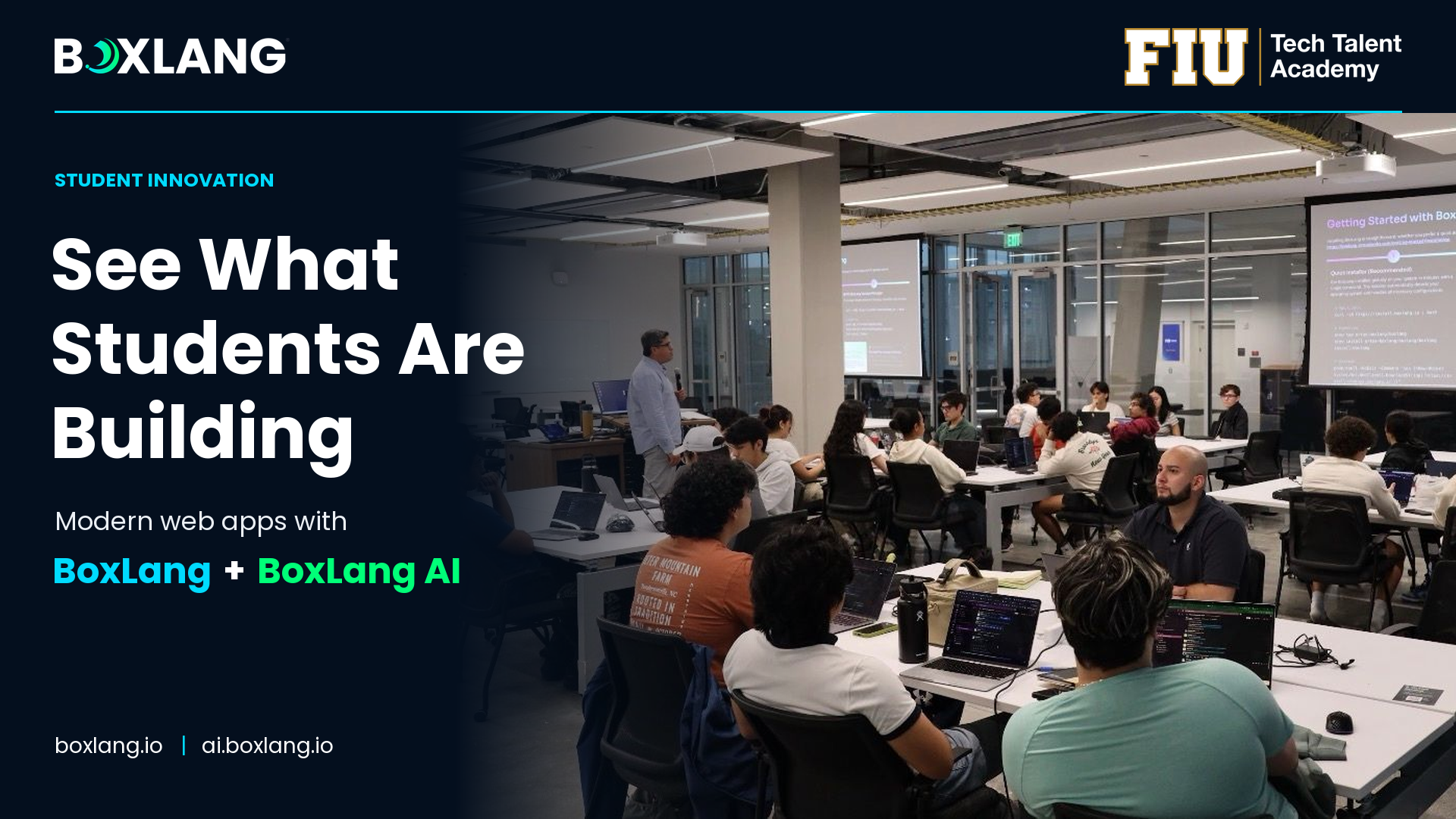
FIU Students Build AI Applications and Contribute to the BoxLang Ecosystem
The ongoing collaboration with Ortus Solutions connects student developers with BoxLang, the AI-first productivity platform, through real AI projects and open-source mentorship from its maintainers.
MIAMI — Monday November, 2026 — Florida International University students are gaining hands-on software development experience through an ongoing collaboration with Ortus Solutions, building applications with BoxLang and BoxLang AI while exploring opportunities to contribute to the technologies themselves.
The collaboration brings together two complementary experiences: developing working AI prototypes and participating in a semester-long open-source project through FIU’s CIS 3590 course. Students practice researching problems, designing solutions, testing code, and responding to feedback from experienced engineers.
The Fall 2026 initiative gives emerging developers experience working within active software projects while introducing technology leaders and educators to practical applications of BoxLang and BoxLang AI.
What Students Are Building
During the September 2026 FIU workshops and hackathon, student teams demonstrated four working prototypes addressing software development and education. All of the student teams built on BxAgents, BoxLang’s new convention-based framework for AI agents, which turns a simple structure of files and folders into a runnable agent application.
- Pipeline Doctor analyzed a GitHub repository, proposed a bug fix, and generated a pull request for human review. When the team encountered usage limits, it switched AI providers and continued developing, demonstrating BoxLang AI’s provider-agnostic design.
- Agent Factory coordinated architect, builder, coder, and QA agents to generate and validate software projects from a user prompt.
- Study Buddy transformed uploaded documents into an interactive learning experience with document-grounded answers, quizzes, explanations, and progress tracking.
- BX Forge generated specialized AI agents for reviewing code against selected standards, security requirements, or technology stacks.
The prototypes show how quickly new developers can turn AI ideas into working software with BoxLang. Each provided a working foundation for further testing and development before potential production use. Read the previous FIU announcement.
AI Built In: BoxLang AI
BoxLang AI is BoxLang’s native AI layer: one fluent API for 15+ model providers, agents, tools, memory, RAG, and MCP.
These capabilities help developers connect models with useful information and actions. An application can retrieve relevant content from documents, maintain conversational context, call an external service, or coordinate several steps in a workflow.
For students, this creates opportunities to explore the architecture behind an AI application. A document-based study assistant, for example, requires decisions about how information is retrieved and how answers relate to the source material. A code-review agent requires instructions, access to relevant code, and a process for evaluating its recommendations.
For engineering teams, the same building blocks can support experiments with internal knowledge assistants, developer tools, and workflow automation. BoxLang AI’s support for multiple providers gives teams options as they evaluate models against their requirements. Explore the framework, examples, and documentation at BoxLang AI.
Why BoxLang: AI-First Productivity on Any Runtime
BoxLang is an AI-first, open-source productivity platform: a modern dynamic language built so teams can ship AI-powered applications, APIs, and automation quickly. On the JVM, it also gives developers direct access to Java classes and libraries.
For Java teams, this creates opportunities to reuse existing libraries while introducing a dynamic language for scripting, automation, application logic, and experimentation. Developers can call Java code from BoxLang and embed BoxLang scripting into Java applications through the standard JSR-223 scripting interface. Explore BoxLang’s Java integration.For Java teams, this creates opportunities to reuse existing libraries while introducing a dynamic language for scripting, automation, application logic, and experimentation. Developers can call Java code from BoxLang and embed BoxLang scripting into Java applications through the standard JSR-223 scripting interface. Explore BoxLang’s Java integration.
For example, a team could retain an existing Java library for business rules or data processing and use BoxLang to coordinate a new workflow around it. Students can explore the same approach as they learn how application components work together.
BoxLang can also participate in applications built with other languages through HTTP APIs and service integrations. This gives teams a practical way to introduce a BoxLang component into a broader architecture, choosing the integration approach that fits their existing systems.
Contributing to the BoxLang Ecosystem
The Fall 2026 CIS 3590 collaboration is an active, ongoing project in which FIU students work with Ortus Solutions mentors to contribute to the BoxLang language and its development tools.
Ortus Solutions has provided FIU students with 100 candidate issues:
- 68 BoxLang issues
- 23 BoxLang IDE issues
- 9 MatchBox issues
The project is still underway, with students working alongside mentors to investigate bugs, develop enhancements, and improve testing, documentation, and developer tooling across the BoxLang ecosystem. These figures represent the candidate issues provided for the collaboration, rather than completed fixes or merged pull requests. Additional opportunities may be identified as the project progresses.
Students begin by understanding an issue and researching the relevant code and documentation. They discuss their proposed approach with a mentor before implementing, testing, and documenting a change. Pull requests then provide a setting for technical feedback and revision.
Through this process, students gain experience working within an active open-source codebase while helping improve the language, tools, and resources available to the BoxLang community.
Learning Directly from Maintainers
Ortus Solutions engineers support the semester project as technical mentors and reviewers, helping students evaluate approaches, work through blockers, and improve their contributions.
Students retain ownership of their research and implementation. FIU manages course instruction, grading, and academic assessment.
The collaboration also gives the BoxLang team valuable feedback. Questions from new contributors can reveal opportunities to improve documentation, clarify examples, and make onboarding more accessible.
For technology leaders and educators, these experiences provide concrete examples of how mentorship and open-source participation can connect technical learning with professional development practices.
Explore the Technology and Start Building
Students, developers, and engineering teams can explore the technologies used throughout the collaboration:
- Discover BoxLang: boxlang.io
- Explore BoxLang AI: ai.boxlang.io
- Build agents with BxAgents: bxagents.ai
- Try BoxLang in your browser: try.boxlang.io
- Get started with BoxLang AI: ai.ortusbooks.com/getting-started
- Read the documentation:boxlang.ortusbooks.com
Universities and organizations interested in workshops, student projects, technical mentorship, or development partnerships can contact Ortus Solutions to discuss opportunities.
About BoxLang
BoxLang is an AI-first, open-source productivity platform and modern dynamic language from Ortus Solutions. With native AI capabilities through BoxLang AI, Java interoperability, modular extensibility, and multiple runtimes, it helps teams build applications, APIs, agents, and automated workflows faster.
About BoxLang AI
BoxLang AI is an AI development framework for the BoxLang ecosystem. It provides a unified API for working with model providers, agents, tools, memory, retrieval-augmented generation, vector databases, and Model Context Protocol integrations.
About Ortus Solutions
Ortus Solutions is a software development and professional services company founded in 2006. The company develops BoxLang and open-source developer tools and provides application development, architecture, consulting, training, and support services.
Media Contact
- Maria José Herrera
- Marketing Specialist
- Ortus Solutions
- Software Development Company
- Email: mherrera@ortussolutions.com
- Website: ortussolutions.com
- Website: boxlang.io
- Website: ai.boxlang.io





Add Your Comment