

One of the most useful features of CommandBox is the ability to start an ad-hoc server quickly and easily. Any folder on your hard drive can become the web root of a server. To start up the server, cd into a directory containing some CFML code, and run the start command. An available port will be chosen by default and in a few seconds, a browser window will open showing the default document (index.cfm).
CommandBox> cd C:\sites\test
CommandBox> start
To stop the embedded server, run the stop command from the same directory.
CommandBox> stop
OS Integration
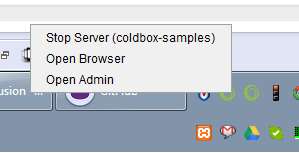
You can start as many embedded server instances as you want. Each running server will add a little green "Ortus" icon in your system tray. Right click on it for options:
- Stop Server
- Open Browser
- Open Admin
Full Control
CommandBox's embedded server does not require any prior installations of any CFML engine to work. It does not use Apache, IIS, or Nginx. A very lightweight Java web server called Undertow is used and a context is programmatically deployed via a WAR file.
You should still have all the options you need to set up most local development servers quickly. The web-based administrator is available to you where you can edit any setting, add data sources, CF mappings, and mail servers. To see a list of all the parameters you can pass to the server start command, refer to the CommandBox API Docs or run server start help command directly from the CLI.


Add Your Comment
(9)
Aug 02, 2015 18:55:16 UTC
by ronnie
how can I open server administration using CommandBox in mac?
Aug 02, 2015 19:07:41 UTC
by Brad Wood
Ronnie, the same options shown in the context menu above should be available on the CommandBox icon in your dock. You can also just type in the normal address to the Lucee web administrator. /lucee/admin/server.cfm
Aug 03, 2015 21:56:13 UTC
by Ronnie
Thank you Brad :) It works
Sep 24, 2019 17:35:39 UTC
by David Levin
Is Undertow suitable for hosting production websites? Or does Ortus recommend deploying to another web server like Apache, IIS, or Nginx?
Assuming Undertow is okay for production use, how would one configure Undertow's configuration say, for example, you want to create rewrite rules, HTTP/HTTPS redirects, etc?
Sep 24, 2019 17:57:54 UTC
by Brad Wood
David, Undertow is a very capable and performant web server. I've done head-to-head test against Nginx and Apache serving static files and it has the same throughput. The only downside I'd say is if you were serving large binaries files and didn't want the JVM to be touching them. Otherwise, it's totally acceptable to use undertow directly so long as you take the normal lockdown steps.
We support URL rewriting and blocking of paths via Tuckey Rewrites which are covered in the docs. I can answer any more specific questions as well as share some common lockdown configs on Slack.
Nov 01, 2019 13:03:37 UTC
by Bluezoom
Hi Brad -Is there a way to specify which browser Commandbox auto opens when launching a server? We would like to specify one other than the default browser,
Nov 01, 2019 13:19:54 UTC
by Brad Wood
Hi Bluezoom, right now CommandBox uses whatever the default browser is for your operating system. We can look into somehow overriding that, but right now it just delegates out to a system call and lets the OS handle it. The process also varies based on whether you have Windows, Mac, or Linux.
Nov 01, 2019 13:24:34 UTC
by Bluezoom
Thanks Brad! It would be great to be able to specify a browser path in the config file, or use the default if that value is blank or nonexistent.
Nov 01, 2019 13:28:51 UTC
by Brad Wood
Here's the existing ticket for that: <a href=