
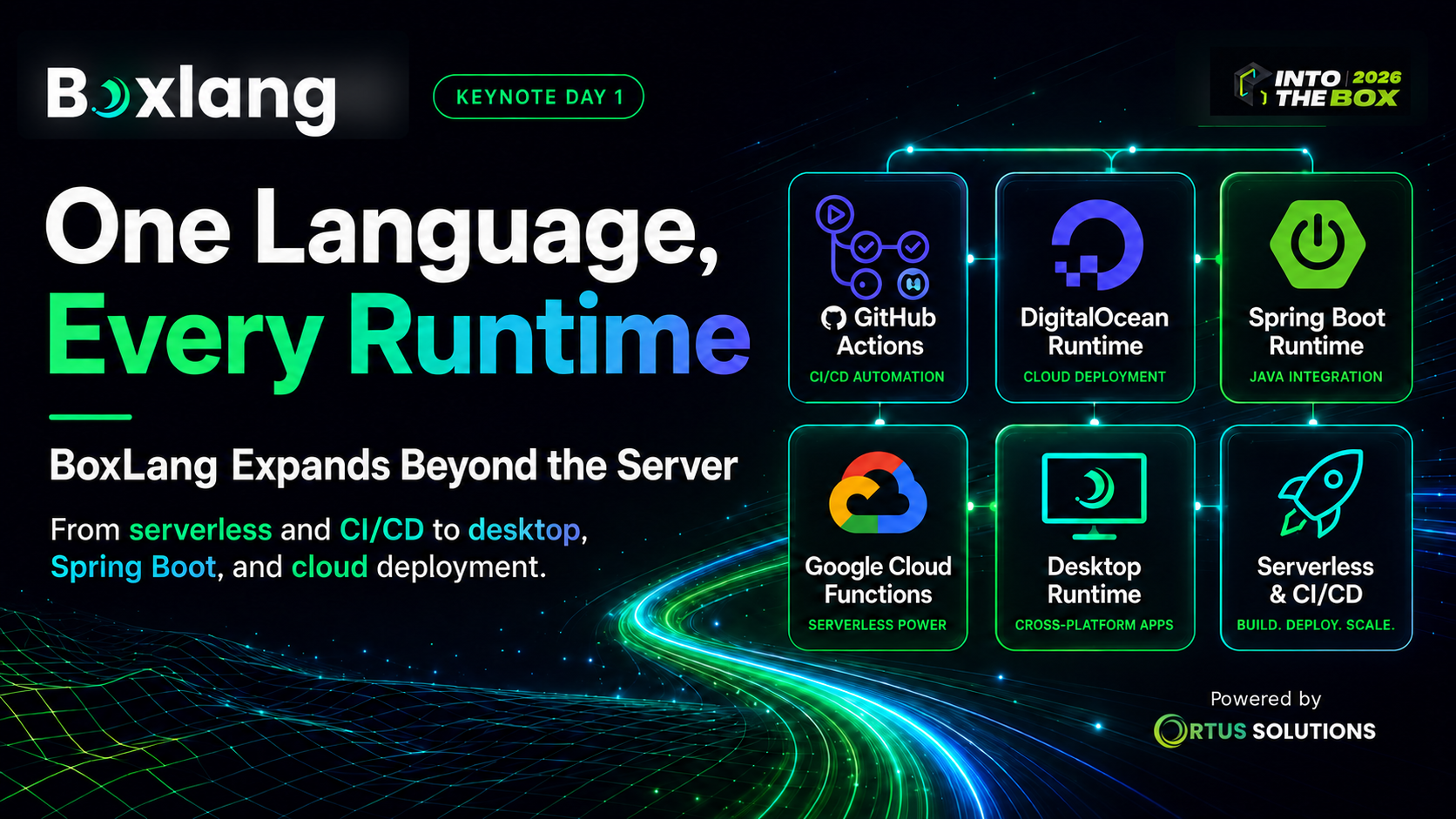
One Language, Every Runtime!
Modern applications no longer live in just one place.
Developers are building for cloud functions, containers, CI/CD pipelines, Java applications, desktop tools, server environments, and local automation workflows. But every new environment often comes with its own setup, deployment model, tooling requirements, and learning curve.
BoxLang’s multi-runtime architecture is designed to change that.
Instead of forcing developers to rewrite logic, switch languages, or rebuild workflows for every platform, BoxLang gives teams one consistent language and ecosystem that can move across different runtime targets.
The result is simple but powerful:
Build with one language. Run across more environments.
After only 11 months, BoxLang is already expanding fast, giving developers more flexibility in how they build, deploy, automate, and modernize applications.
Beyond the Traditional Server
From the beginning, BoxLang was built around a clear idea:
Dynamic languages should not be confined to the server anymore.
That vision shaped the foundation of BoxLang’s multi-runtime architecture. Instead of tying developers to a single deployment model, BoxLang gives them the flexibility to use the same language, syntax, tooling, and ecosystem across different environments.
At launch, BoxLang already supported a wide range of runtimes and integrations, including:
- OS / CLI
- JSR-223
- CommandBox
- MiniServer
- AWS Lambda
- Jakarta EE
- Docker
- Language Server Protocol support
This immediately positioned BoxLang as more than another JVM language. It became a platform designed for flexibility from day one.
For developers, that means BoxLang can be used not only for traditional server-side applications, but also for automation, scripting, local tooling, cloud deployments, Java integrations, and modern application workflows.
And now, that runtime ecosystem continues to grow.
BoxLang Multi-Runtime Development: One Ecosystem, More Places to Build
One of the most important parts of BoxLang’s evolution is its expanding runtime ecosystem.
BoxLang is giving developers a consistent way to build across different environments without having to constantly change tools, rewrite code, or rethink the application structure for every platform.
Today, BoxLang’s growing runtime ecosystem includes:
- GitHub Actions Runtime
- DigitalOcean Runtime
- Spring Boot Runtime
- Google Cloud Functions Runtime
- BoxLang Desktop Runtime
These additions expand what developers can do with BoxLang across CI/CD workflows, cloud platforms, Java ecosystems, serverless applications, and desktop experiences.
That means BoxLang is not only helping developers build applications. It is also helping them automate workflows, simplify deployments, modernize existing systems, and create new types of tools using the same language and ecosystem.
Serverless Without the Provider Lock-In
Serverless development is powerful, but it can also become complicated fast.
Every provider has its own structure, configuration, deployment model, and workflow. For teams trying to build portable cloud-native applications, that can create extra friction.
BoxLang’s growing serverless support is designed to make that experience more consistent.
The goal is to move toward a serverless framework where developers can write code once and deploy across different serverless providers without having to rethink the entire application every time.
Current and upcoming serverless work includes:
- AWS Lambda support
- Google Cloud Functions support
- URI routing
Application.bxsupport- Starter templates
- Azure Functions in progress
For teams exploring cloud-native development, this helps reduce one of the biggest barriers to serverless adoption: provider-specific rewrites and setup complexity.
With BoxLang, serverless development becomes more portable, approachable, and consistent.
GitHub Actions Runtime: BoxLang Inside Your CI/CD Workflow
The GitHub Actions Runtime brings BoxLang directly into automation and CI/CD pipelines.
This runtime allows developers to quickly install BoxLang, choose any version, work with or without CommandBox, and integrate automation workflows using:
- CommandBox modules
- BoxLang modules
- ForgeBox integration
- GitHub-native workflows
For teams already using GitHub to build, test, and deploy applications, this creates a smoother path for automation.
It also expands where BoxLang can be useful. BoxLang is not only for building applications; it can also support the workflows around those applications.
From build tasks to deployment pipelines, developers can use BoxLang as part of their daily automation toolkit.
DigitalOcean Runtime: Simple and Affordable Cloud Deployments
The DigitalOcean Runtime gives developers a practical path to deploy BoxLang applications in the cloud.
The workflow is intentionally straightforward:
Clone. Code. Deploy.
According to the keynote, developers can deploy BoxLang applications starting at around $5/month, making this runtime especially attractive for smaller teams, startups, prototypes, side projects, and production workloads that need a simple path to the cloud without heavy infrastructure overhead.
This matters because not every application needs a complicated deployment setup.
Sometimes developers just need a clean, affordable way to ship quickly, test ideas, and keep moving. The DigitalOcean Runtime helps make that possible while staying within the BoxLang ecosystem.
Spring Boot Runtime: A Modern Path for Java Teams
The Spring Boot Runtime is one of the most strategic additions for Java teams and enterprise developers.
This runtime allows developers to embed BoxLang directly into Spring Boot applications, using BoxLang as a templating and application layer inside existing Java ecosystems.
It includes support for:
- Seamless Java integration
- BoxLang View Resolver
- Full web scopes
- Spring model integration
- Lifecycle management
- Shared application configurations
For organizations already invested in Java, this creates a more realistic modernization path.
Instead of requiring a full rewrite or a complete change in architecture, teams can introduce BoxLang where it brings value. They can improve productivity, modernize pieces of the application, and continue working within the systems they already trust.
For enterprise adoption, that flexibility matters.
BoxLang Desktop Runtime: Build Desktop Applications With BoxLang
One of the most exciting additions to the runtime ecosystem is the BoxLang Desktop Runtime. For the first time, developers can build desktop applications directly with BoxLang.
The first runtime is powered by Electron, allowing developers to create cross-platform desktop applications for:
- Windows
- macOS
- Linux
The Desktop Runtime already includes:
- Starter templates
- Application hooks
- Built-in loading screens
- Theming support
- MVC/ColdBox desktop templates
This opens the door to a completely new category of applications for BoxLang developers. Internal tools. Admin utilities. Diagnostics apps. Local developer tools. Cross-platform productivity apps. Desktop-first workflows. With the Desktop Runtime, BoxLang moves beyond the server and into the daily tools developers and teams may need to build for their own operations.
BoxLang Admin Desktop: Manage Your BoxLang World From One Place
Alongside the Desktop Runtime, the keynote also introduced the BoxLang Admin Desktop experience. The goal is to give developers one place to manage their BoxLang installation, runtimes, configuration, and tools from a desktop interface.
BoxLang Admin Desktop is designed to help developers:
- Manage runtimes
- View and edit runtime configuration
- Use REPL and scripting tools
- Build and manage BoxLang desktop applications
- Work with a secure and reliable local experience
For developers working across multiple runtimes, this matters.
As the BoxLang ecosystem grows, teams need better visibility and easier control over their environments.A desktop admin experience helps make runtime management more approachable, especially when working across local development, serverless, desktop, and cloud deployment targets.
Watch the Keynote Segment
Want to see this part of the keynote in action?
Watch the Into the Box 2026 Keynote Day 1 segment where the team walks through BoxLang’s multi-runtime development, including serverless, GitHub Actions, DigitalOcean, Spring Boot, and desktop runtime updates.
One Language. More Ways to Build.
What makes BoxLang’s multi-runtime architecture so important is not just the number of runtimes available.
It is the consistency across them.
Instead of learning different stacks for:
- Cloud functions
- Desktop apps
- Containers
- Java integrations
- CI/CD workflows
- Serverless deployments
- Runtime management
developers can stay within the same ecosystem and development model.
That consistency helps reduce context switching, simplify modernization, and give teams more deployment flexibility without forcing them to start over every time their architecture changes.
BoxLang’s expanding runtime ecosystem gives developers more ways to build with the tools they already know while reaching new environments that were not traditionally associated with dynamic languages.
From serverless functions to desktop applications, from GitHub workflows to Spring Boot integrations, BoxLang is expanding what a modern dynamic language can do.
And this is only the beginning.
To explore all available runtimes and documentation, visit the official BoxLang website and the BoxLang Docs Portal
Join the Ortus Community
Be part of the movement shaping the future of web development. Stay connected and receive the latest updates on, product launches, tool updates, promo services and much more.
Subscribe to our newsletter for exclusive content.
Follow Us on Social media and don’t miss any news and updates:


Add Your Comment